|
Exhibition promoted by the Fondazione Musei Civici Veneziani
In collaboration with the National Gallery of Washington
Curated by Peter Humfrey, with Andrea Bellieni and Gretchen Hirschauer
Further information and images:
www.studioesseci.net
Mayor Luigi Brugnaro and Mariacristina Gribaudi, President of the Venetian Civic Museums Foundation, announce what promises to be the most eagerly awaited
Venetian exhibition event of the spring season: the major exhibition “Vittore Carpaccio. Paintings and Drawings” which, from 18 March to 18 June, can be admired in
the Doge’s Apartment in the Doge’s Palace.
The major retrospective was made possible thanks to the collaboration between the Musei Civici Veneziani and the National Gallery in Washington. The curatorship of the
project was entrusted to Peter Humfrey, a recognised specialist on the painter and his context, with Andrea Bellieni, curator of the Musei Civici di Venezia, and Gretchen
Hirschauer, curator of Italian and Spanish painting at the National Gallery of Art in Washington.
“The paintings of Vittore Carpaccio (c. 1460/66 – c. 1525/26) celebrate,” emphasises President Gribaudi, “the greatness and splendour of Venice at the turn
of the 15th century, when the lagoon city dominated a vast maritime empire and flourished as a centre of international trade and culture. The artist’s narrative paintings –
especially the famous cycles painted for various religious brotherhoods – transport the sacred stories into real life, placing them in fantastic settings, albeit enriched
with endless details and contemporary references. Inspired by the environment and society of his extraordinary city, Carpaccio combines careful observation of the urban
scene with his particular transport for the poetic and the fantastic”.
“His works, perhaps more than those of other Venetian Renaissance artists, represent the essence of ‘Venetian-ness’, i.e. the opulent spectacle and mythology of the
Serenissima Republic, at that time at its economic and cultural apogee. With this exhibition, Venice celebrates its history, its tradition, and one of its illustrious
painters who, with his art, narrated the City and its beauty, succeeding in handing down to us images of daily life from a past that thus comes back to life,” commented
Mayor Luigi Brugnaro.
Loans generously granted by museums, churches, institutes and private collections, from Europe and the United States, have made it possible to bring back to Venice works
that had been distant from the lagoon for centuries; some were sent by the artist himself to the ancient territories once linked to the Serenissima, such as Istria and
Dalmatia, and never returned until now. They are essential in order to now be able to propose in the rooms of the Doge’s Apartment an itinerary that documents the evolution
of Carpaccio’s art in the most objective and complete manner. Forty-five paintings on religious, profane or genre themes – including some of large dimensions – highlight
the artist’s great imaginative, narrative and descriptive skills, as well as his skilful painting technique. Together with this, a large group of drawings demonstrates his
special ability to ‘study’ reality in minute detail, revealing his particular interests in nature, perspective, the customs of his time and the effects of light.
It should be noted that the previous monographic exhibition dedicated to the Venetian master dates back to 1963. “With this magnificent exhibition, which comes at the
conclusion of discoveries and new attributions, as well as extraordinarily revealing restorations, we are now able to offer the public and scholars an up-to-date
historical-critical rereading of Carpaccio’s painting and its evolution, from its beginnings to his late works, which are usually belittled by critics” says Andrea
Bellieni, Head of the Correr Museum.
“With these essential objectives in mind, the tried and tested collaboration between the Fondazione Musei Civici di Venezia and the National Gallery of Washington, under
the scientific care of Peter Humfrey, has led to the creation of the exhibition project in the two venues of Washington and Venice, based on a targeted selection of the
artist’s most representative works. The intention is to trace, in both thematic and chronological terms, the rigorous development of Carpaccio’s painting from an
up-to-date perspective. In this, the exhibition also benefits from a substantial nucleus of autograph drawings by the painter, author of the largest surviving corpus of
early Renaissance ‘study’ drawings,” adds Chiara Squarcina, Director of Museum Activities.
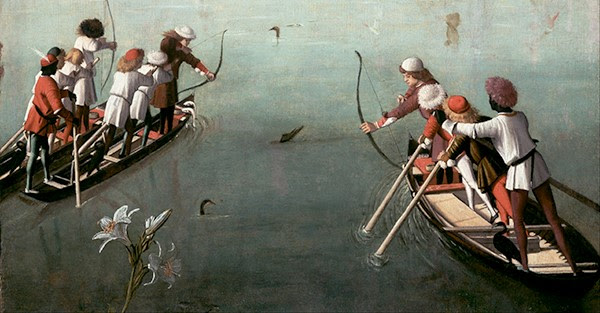
The exhibition also offers the truly unique opportunity to admire, finally reunited, the two parts of an already accomplished and unified scene, separated in unknown
circumstances towards the end of the 18th century: the “Two Ladies” from the Correr Museum, owned in Venice by Teodoro Correr, are reunited with the
“Hunting in the Lagoon“, formerly in Rome in the collection of Napoleon’s cardinal uncle and now in the Getty Museum in Los Angeles; thus the perturbing scene
with the two elegant Venetian noblewomen boredly awaiting the return of their husbands from hunting in the lagoon with bows and ‘ballotte’ is reformed; a psychological
‘story’ told by Carpaccio with subtle sensitivity and sublime imaginative fascination (the great English historian John Ruskin at the end of the 19th century was literally
subjugated by it), painted on what was almost certainly originally a folding door leaf placed between two rooms of a refined, very private Venetian interior.
Finally, for the passionate visitor, the exhibition can only continue outside the Doge’s Palace, in a city itinerary that, following in the footsteps of the great
travellers, writers and aesthetes of the late 19th century – those who literally rediscovered Carpaccio’s greatness and charm – reaches above all the painter’s two
masterpieces, complete and intact in their original or chosen location: the St. Orsola cycle in the Accademia Galleries and the St. Giorgio degli Schiavoni
cycle in the Scuola of the same name.
|