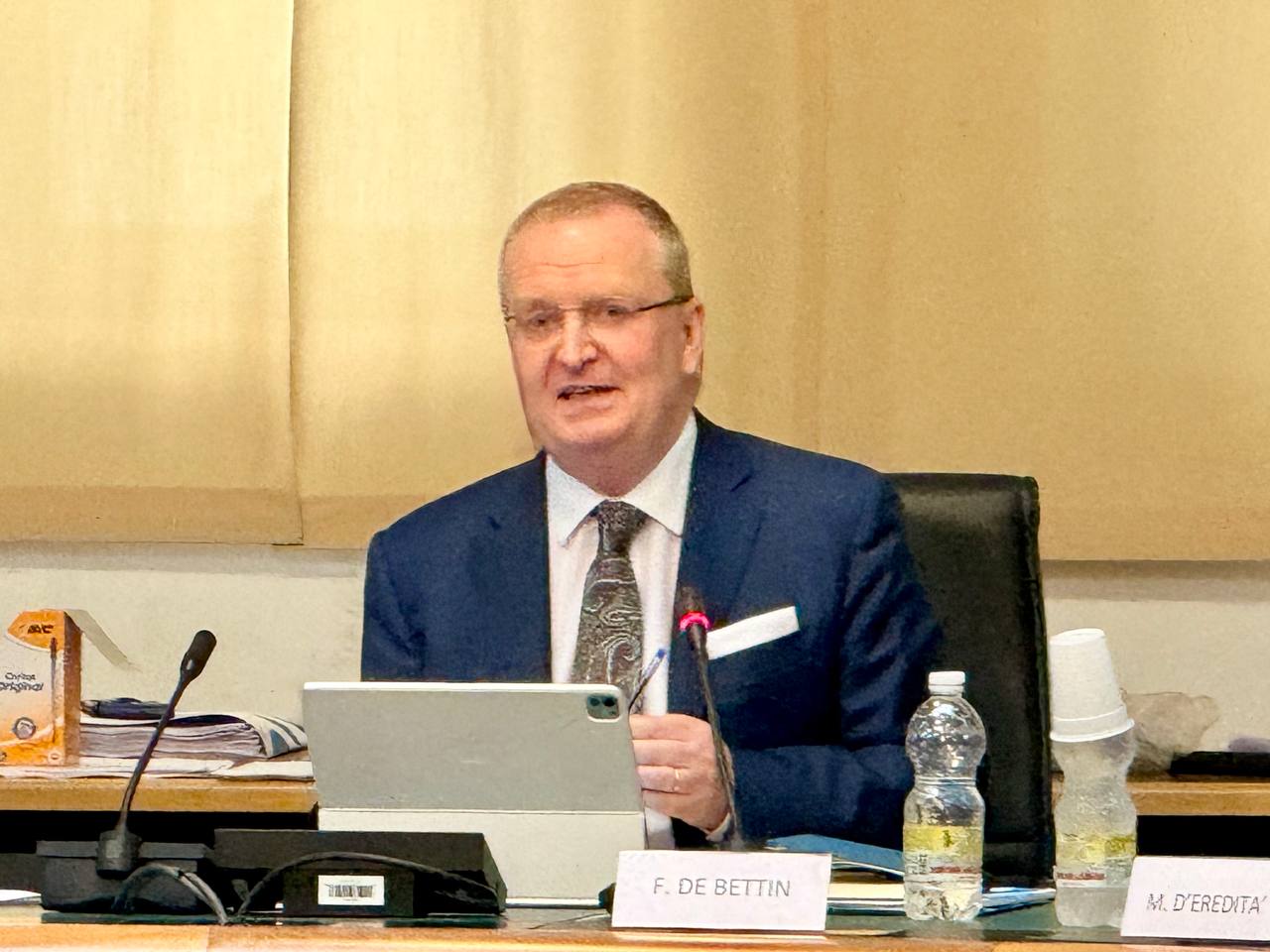
On February 20, Unioncamere Veneto and the Treviso-Belluno|Dolomiti Chamber of Commerce held a press conference at the Chamber of Commerce on the economic situation in the fourth quarter of 2025 and the digitization of Veneto businesses.
During the press conference, data on the economic performance of the manufacturing industry in the fourth quarter of 2025 was presented, with details for the Treviso and Belluno regions.
Speakers included:
- Mario Pozza
President of the Treviso-Belluno|Dolomiti Chamber of Commerce - Antonella Trevisanato
Unioncamere Veneto Research Department - Federico Callegari
Research and Statistics Office, Treviso-Belluno|Dolomiti Chamber of Commerce - Giancarlo Corò
Professor of Applied Economics, Department of Economics, Ca’ Foscari University of Venice. - Eleonora Di Maria
Professor of Economics and Business Management, ‘Marco Fanno’ Department of Economics and Business Sciences – DSEA University of Padua
Statement by the President of the Treviso-Belluno | Dolomites Chamber of Commerce – MARIO POZZA
The manufacturing sector in Treviso also saw a positive trend in production (+2.0%), marking a turnaround compared to the first part of the year. Order intake also returned to growth,
albeit slightly: both domestic and foreign orders saw a year-on-year increase of +1.3%.
Two opposing trends are affecting this figure: on the one hand, the recovery of industrial machinery, and on the other, the negative trend in the wood-furniture sector, whose exports fell by 5.5% in the first nine months, rising to 10.4% if we look at sales in the US (in terms of the impact of tariffs). There are no strong signs of recovery for this sector in the last part of the year either: the year-on-year increase in foreign orders stands at +0.4%.
The forecasts for the first three months of 2026 show a reduction in the concerns noted in June: all indicators (production, turnover, domestic and foreign demand) show an increase in “optimistic” assessments and a corresponding decrease in “pessimistic” ones. However, there is still an awareness of how complex and uncertain the scenarios remain, given that almost 1 in 2 entrepreneurs believe that a scenario of stagnation is more plausible for foreign demand.
Belluno’s manufacturing sector is seeing growth in production again after eight consecutive quarters of decline and two of stagnation: an indicator that is also driving up the degree of
plant utilization: now at 71.4%, when in the previous three quarters it had fallen to 65%, clearly suggesting that a third of the territory’s production capacity was unexpressed.
The recovery in turnover is two-speed: foreign turnover is doing well, with a trend variation of +3.3%. Total turnover is still at a standstill (+0.3%). The recovery in Belluno’s foreign turnover is being driven in particular by larger companies (with over 50 employees) operating in the metalworking sector (“cold chain”). This is also confirmed by ISTAT export data, which in September showed a 14% increase in foreign sales of industrial machinery made in Belluno.
In the eyewear sector, however, the situation appears more controversial. The recovery in foreign sales is less intense, while total sales are down sharply in the small business segment, confirming a certain degree of suffering in the local eyewear supply chain. In the first nine months of the year, foreign trade data showed a 40% decline in eyewear exports to the US (-€277 million compared to the previous year’s export volumes).
However, the fourth quarter saw an interesting recovery in foreign orders (+6.2%), mainly thanks to the metalworking industry. The outlook for the first three months of 2026 is much better than in June, but a wait-and-see attitude prevails, especially with regard to the stability of demand.
Our further analysis focuses on this uncertainty surrounding demand. Our analysis of the impact of tariffs has shown us that not only companies that export directly to the US are exposed to the risk of tariffs, but also those that do not, but are affected by them through the global value chains in which they operate. These are mainly companies operating in the intermediate goods sector: mechanical engineering, but also wood and furniture.
Several companies have the strength and capacity to implement adjustment strategies, especially in terms of diversifying their output markets. However, the data also show that a number of companies, despite being negatively affected by tariffs, are not changing their strategy: it is unclear whether they are simply waiting to see what happens (hoping that this is a temporary and non-systemic shock) or whether they are doing nothing because they do not have the tools to react and need help.
This is where the need to stop procrastinating on the Free Trade Agreements signed by the EU with the Mercosur countries and India comes in, as these can facilitate market diversification. I fully agree with Draghi’s warnings: in this destabilized global order, it is truly essential to decide whether, as Europeans, we want to remain just a market subject to the priorities of others, or whether we want to write our own agenda. I believe that these agreements are a step in this direction and that reservations, which only harm our economy, should be removed.
These agreements are based on very interesting trade volumes: in 2024, Veneto’s exports to Mercosur were worth over €740 million, and imports exceeded €880 million. In the same year, Veneto exported goods worth over €650 million to India, with imports of almost €760 million.
But I believe that these figures are only the starting point: not only to increase trade but also to develop industrial partnerships, including those related to strategic supplies. If we have passively endured geopolitics until now, it is time to change the scale of our reactions and decisions. In this context, the chamber system
is well equipped to implement all the necessary measures to accompany businesses in this world, which is no longer the world of yesterday.
Statement by the President of Unioncamere Veneto – ANTONIO SANTOCONO
After a long series of negative or stagnant six-month periods, Veneto’s manufacturing sector confirms a weak but positive reversal of the trend, which began in the third quarter of 2025, both in terms of production and turnover.
The trend in production in the fourth quarter was +1.7%, accompanied by an increase in capacity utilization (from 70.5% in the middle of the year to the current 72.2%).
A similar trend can be seen in turnover: negative in the first six months of 2025, positive in the second half, with a slight upward trend (from +1.7% to +2.1%), again on an annual basis.
Above all, foreign orders are recovering despite tariffs and the continuing extremely complex global scenario and widespread uncertainty.
After a period of “calm” in the first nine months of the year, the fourth quarter of 2025 saw a significant increase in foreign orders (+3.9% year-on-year) in sharp contrast to the recent past. The machinery industry benefited most, most likely driven by positive impulses from German fiscal policy.
The production horizon assured by the order book is lengthening again, significantly so, consolidating at around 58 days at the end of the year, compared to 52 days at the beginning of the year.
In the forecasts for the first three months of 2026, entrepreneurs’ sentiment is decidedly better than the concerns gathered in mid-2025.
These are positive signs. But in a situation where we can see the subversion of the world order as we have known it, and given the role of support, guidance, and direction that the chamber system has towards businesses, we felt the need to look beyond the simple economic dynamics and examine the real impact of tariffs, the potential volumes at stake in terms of market diversification with free trade agreements with Mercosur and India, and the strategies and tools businesses are using to respond.
We did this together with leading experts from our universities, Ca’ Foscari Venice and Padua. This revealed some interesting findings.
On the one hand, there is a rather heterogeneous picture of the impact of tariffs, with direct and indirect effects that vary according to the size of the companies concerned and their production and commercial links.
On the other hand, there has been a significant increase in investment in digital technologies by manufacturing companies in Veneto, with artificial intelligence becoming a priority for over a third of the companies surveyed.
Manufacturing companies in Veneto seem to have understood that process efficiency also requires a rethinking of business models and the ability to quickly process information with a more adaptive approach to unpredictable scenarios.
In conclusion, I believe that with this detailed, rich, and comprehensive analysis, Unioncamere del Veneto and the regional chamber system are giving substance and added value to their mission of supporting the growth of local economic systems, especially small and medium-sized companies, thanks to the various tools—training, financial, and support—that we make available to all businesses.