Read the key concepts from President De Bettin’s inaugural address

Guiding principles for the 2026-2031 term


Economy - published on 17 August 2026


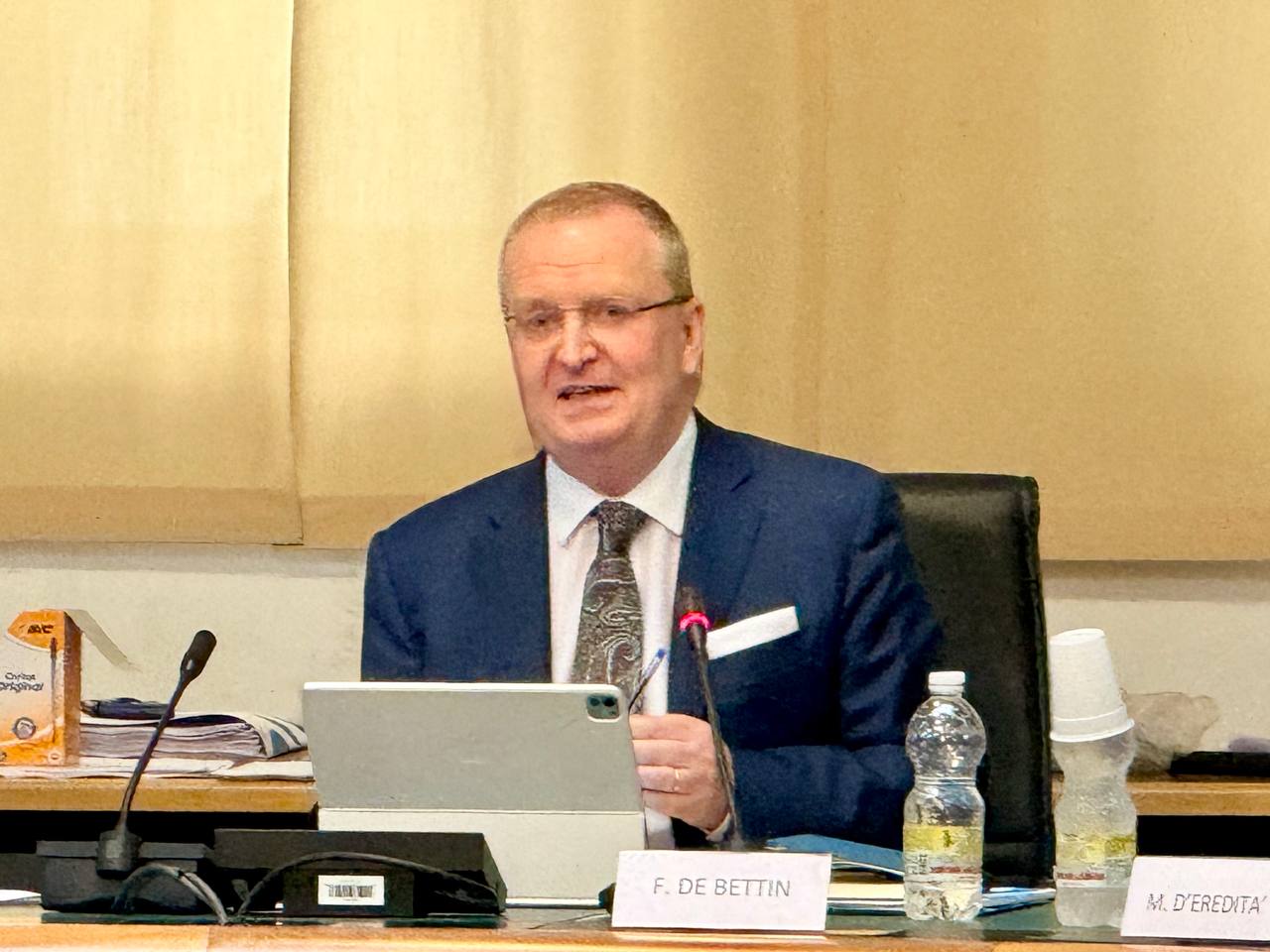
By Francesco De Bettin, Engineer, President of the Treviso-Belluno|Dolomiti Chamber of Commerce

We all owe you something

I’d also like to thank those who chose to appoint me to the challenging role of president of the Chamber of Commerce for a region like ours, which corresponds to the northern part of the Veneto Region.

This public institution faces momentous challenges, the first of which will be to demonstrate how two places so different in terms of history and industrial and entrepreneurial districts can combine their respective strengths without losing the commitment to “craftsmanship” that has always distinguished and set apart Treviso and Belluno-Dolomiti.

Before delving into the reflections I wish to share with you, however, I feel compelled to make a brief clarification.

What follows will not be a governing program for the Chamber of Commerce!

That program must emerge, as it should, from discussions with the Board, the Executive Committee, the Secretary General, the organization’s staff, and all the economic and social stakeholders that this institution represents.

Guiding principles

Today, here, I would rather propose an analysis of the context and some guiding principles upon which, together, we can build a governance model capable of interpreting change rather than merely enduring it.

A governance model that knows how to be, with humility but also with courage, a “builder of the future,” while at the same time preserving and strengthening the quality of the institutional services that the Chamber already offers to businesses.

This is a goal we can achieve only by making the most of this institution’s most important asset: the women and men who work here today and those who will help it grow tomorrow.

I will certainly have to learn something from everyone, because the path that has brought me here is that of an engineer born in the mountains and proud of his roots.

An engineer who, from the day I graduated until now, has always been engaged in the world of private enterprise, which, as you well know, a single calling, indeed, a single imperative: to grow his own business within a cultural, legislative, political, and institutional system that seems designed specifically to prevent companies from thriving and to stop the wealth they generate from trickling down to every social stratum, thereby making society as a whole more harmonious.

As a great man, whom we will never cease to mourn, once said:

“Thousands of individuals produce and save despite whatever the state devises to harass, hinder, and discourage them.”

These warnings are drawn from the sharp and forward-thinking insights of Luigi Einaudi, who believed that excessive taxes, stifling bureaucracy, and rules imposed from above were burdens (he called them “obstacles”) that the state placed on the shoulders of those who want to do business.

From the 1940s to the present, as you can see, we have managed to change very little in Italy, and even in our own regions.

And yet, we want to keep trying

Not least because we are here in the heart of the region that, a geological era ago, called for greater autonomy through a referendum.

But despite the goodwill and hard work of those who have tried, we have seen very little come of that driving force, especially if we consider what the great constitutionalist, the father if we may call him that, of the autonomy movement, Mario Bertolissi, has written just in recent days:

“Too much time has passed without achieving anything. The imbalances between the various regions have not been eliminated, and what is serious is that a pantheistic conception of the state is rampant, one that cannot be remedied with half-measures or by merely muddling through.”

Principle of subsidiarity

It’s certainly not up to me to draw conclusions about this matter, but I do believe it’s necessary to leave it to politicians to untangle the mess they’ve created, and to try to move forward by demanding the application of that principle of subsidiarity, which is struggling to take root throughout Europe.

The French philosopher Chantal Delsol put it well in the 1980s and 1990s. And before her, I recall the other great theorist of subsidiarity, that Sicilian priest named Luigi Sturzo, whose thought inspired me as a young student when I was studying the encyclical Quadragesimo Anno, promulgated by Pius XI in 1931.

On January 18, 1919, in his appeal to the “free and strong,” Don Luigi denounced as suffocating and illiberal the idea of a state that takes care of you from the cradle to the grave.

The state must recognize the limits of its presence and value natural units and institutions, first and foremost the family and the business.

For, as Delsol writes, subsidiarity is the principle that places the person at the center and, indeed, limits the powers of the state.

Keeping things simple is what defines subsidiarity: decisions and assistance must be provided at the level closest possible to citizens, and the state intervenes only when individuals or smaller communities cannot manage on their own.

Only in this way will we not be transformed from citizens into subjects.

The “subsidiary state” acts as a guarantor and never as the main actor.

Where local networks are insufficient, then, and only then, does the public institution step in, supporting private initiatives without taking their place.

In short, we must begin to champion simple solutions that truly help us, as I intend to do during our term leading the Chamber of Commerce that governs Northern Veneto.

Of course, applying subsidiarity requires the courage to renounce “egalitarianism”, where everyone receives exactly the same things from the state, and this approach promotes the dignity and value of each person’s differences.

I know, the pantheistic state, the monster that absorbs the rest of social reality into itself, to borrow the words of Professor Bertolissi, thinks and, above all, acts differently; but we, who experience every day the cultural richness that comes from our businesses, know that what will save us is the consistent application of subsidiarity, a concrete and constitutional principle.

Speaking of the future, let’s delve into the present of our system, which we still struggle to perceive.

Workers of our future

You see, I am convinced that we are in the midst of an epochal transition and that being the “workers of our future” means bearing in mind very concrete responsibilities.

The first of these is knowing that the past is truly behind us.

The model that allowed us to prosper, setting aside certain distortions that existed even back then, such as tax evasion, undeclared work, and speculation against the national currency, no longer exists, and the rest of the world and Europe remind us of this every day.

Let me give you an example that strikes me as particularly clear.

As I mentioned, I come from the mountains and from a family that could not have been more patriarchal.

Or rather, matriarchal, because it was above all our mother who shaped the determination of us four siblings to live and understand the world both on our own and together.

I can’t help but be proud of being a man of the provinces, that is, a man of essential values and traditions, but this is quite different from the provincialism that is scorching our manufacturing districts, still afflicted by parochialism, whereby everyone must possess, on a small scale, the same structures and the same modest business models.

The world has already changed, and we must first and foremost transform our mental and cultural frameworks.

Our brilliant and sharp-minded scholar, Giulio Buciuni, puts it well when he describes our suburbs, which are losing their competitiveness, mired as they are in tradition and, above all, by the emergence, elsewhere, of a system that concentrates metropolises into a few global hubs where expertise and capital coalesce around large corporations, universities, and research centers.

It is, in fact, called a “system,” and it is the framework that defines that complex reality which arises and thrives when we stop thinking only of our own particular interests and instead put our specific capabilities at the service of a larger organism within which we are constantly transforming ourselves to achieve greater competitiveness.

In just a few years, the Veneto region has lost its financial centers along with a great deal of our money, yet we have not yet been able to analyze the reasons why.

We are losing our young people, who are drawn to places that have been able to invest more and better than we have, and we have not yet implemented strong measures to retain them.

Over the years, our decision-making bodies have failed to address issues that are now coming back to haunt us due to our inaction.

I am thinking, for example, of railway routes that were never fully analyzed or discussed before, decisions that would have been painful for some but necessary for everyone.

Yesterday’s failure to act has now become a massive red light that halts or slows down essential projects.

I could go on, but the reports published by the Bank of Italy on the economies of Veneto and Emilia-Romagna speak for themselves better than I ever could.

Dear colleagues, the comparison that emerges is harsh, unforgiving, and cruel. But for us Venetians, it is certainly not final.

In 2025, Emilia-Romagna recorded 0.5 percent growth, in line with the Italian average and that of the Northeast, while Veneto essentially stagnated, with an increase of 0.1 percent.

Labor market

The labor market in Emilia-Romagna was also much more dynamic: employment grew by 2 percent, while in Veneto it declined by 1.3 percent, and the net change between hires and terminations, though still positive, was nearly halved compared to 2024.

Credit quality also improved in Emilia-Romagna, and by the end of the year, lending to businesses had stopped declining.

I see no point in going on, especially since the investments that helped build Motor Valley demonstrate these regions’ ability to function as a cohesive “system.”

Today, the Motorvehicle University of Emilia-Romagna (MUNER) brings together four major universities (Bologna, Ferrara, Modena, Reggio Emilia, and Parma) and 18 leading companies from Motor Valley, offering international master’s programs such as Advanced Automotive Engineering.

And after the data center in Ponte San Pietro in the province of Bergamo, the one operated by Aruba, let’s all go admire the Bologna Technology Park: over 120,000 square meters in the heart of the region’s Data Valley, home to Leonardo, currently ranked twelfth on the Top500 list of the world’s most powerful supercomputers.

I am opposed

I am opposed (and my biography proves it) to what the Australian polemicist and thinker Robert Hughes has called the “culture of whining,” which, in his view, is the corpse of liberalism.

I am and remain a proponent of liberalism and democracy, but let’s be clear: precisely because I am a free-market advocate and an entrepreneur, I believe it is time to tell ourselves, vigorously and without engaging in pointless controversy, that the past is, indeed, the past.

This applies to all our sectors, from agriculture to commerce, from industry to crafts, from tourism to urban regeneration.

If we want to remain the backbone of a society that does not reject the future, we must become the architects of this future, which demands that we change—and quickly.

Thinking, for example, of halting e-commerce is a battle that, at best, will only slow down the inevitable.

Understanding, again for example, how to combine “commerce and tourism” with “agriculture” to produce products of extraordinary excellence means thinking of our region as a holistic district, that is, all-encompassing and integrated, where the consumer is at the center of our commercial activities.

Let’s not repeat the same mistakes we made in the past. 

I wonder

I wonder how many businesses in our extraordinary artisan sector could network to build a high-quality, more efficient, and competitive supply chain.

A supply chain capable of responding to the influx of products from the Pacific region with what they cannot replicate: our knowledge of the materials, our craftsmanship, and the deep-rooted identity of our work.

I believe it is essential to then address the issue of infrastructure, starting with what we already have, but which is now obsolete, not when compared to European standards; but relative to what has been achieved in neighboring regions and territories.

I’m not just talking about railroads, because when it comes to transportation infrastructure, we read about it in the newspapers every day and are amazed by our own frustration.

Rather, I would like to point out the 43 percent loss of water fed into the water supply network before it can reach the taps of our industries, our businesses, and our homes.

I recall that pointless and highly damaging referendum that left this water loss to the inaction of politicians seeking votes.

Speaking of frustration, I want to point out that between Belluno and Treviso, we are major producers of renewable energy from hydroelectric sources, yet we end up paying the same price for that energy here as all those to whom our energy is supplied, effectively giving away our primary resources, in terms of the magnitude of the margin.

I still ask myself: “How many facilities would we need to build to recycle the waste we produce, waste that in Europe is a source of wealth but here is a source of controversy fueled by activist groups and bad politics?”

But, I repeat, we are not the kind to wallow in whining and controversy. I am simply describing the elements of the old that must give way to make room for the new, which, in a nutshell, means we must change our perspective and forge a genuine, deep, and committed alliance among all stakeholders. For example, when it comes to tourism, we must now bring into play not only agriculture but also bio-districts, urban planning, urban regeneration, and communication.

All of this also applies to our most pressing and valuable need: the search for competitively priced energy, a need that affects everyone, from the individual citizen dealing with their cell phone and hybrid car, to agricultural and artisanal businesses, all the way to industry.

We must all demand that ideologies be abandoned, once and for all

We must all demand that the ideologies that have caused damage and high-profile casualties, first and foremost, for example, in the automotive sector, which has been torn apart across Europe, be abandoned once and for all, and that we resolutely move toward that pragmatic, systemic, and unified approach of “technological neutrality” that alone will save us.

Because, you see, the important thing is to make it through to the end of the so-called energy transition alive. Reaching that point without a balanced production system and social system would be pointless.

I say this as an expert in the field.

We need nuclear power; by now it seems obvious to everyone, or at least to almost everyone with a sense of reason.

But while we wait the 15 to 20 years it will take to make that a reality, we need everything else: wind power, solar energy (perhaps with less agri-solar and more use of less sensitive areas), small-scale hydroelectric power connected to wide-area grids, and that low- and medium-to-high-enthalpy geothermal energy, which would be immediately available and, believe me, easier than it seems.

But we must all understand, together, that our system is fragile and that if even one niche fails, the others will fail too, and we’ll all be worse off.

And in Veneto, indeed, especially in this northern part of Veneto, we depend on these niches.

Comprehensive reform of territorial governance

Businesses, too, need a comprehensive reform of territorial governance, one capable of restoring order to jurisdictions, functions, and responsibilities within the framework of a “Wider Area.”

This means overcoming the overlaps and redundancies of intermediate bodies while simultaneously promoting stable forms of collaboration, consolidation, or merger among small municipalities, so that they can share expertise, personnel, and services and have the human capital necessary to establish an administration capable of exerting influence within the “administrative system.”

I’ll conclude with a plea, the only one I’ll make, to the political establishment and to politicians.

We need you; we need well-prepared politicians who read the documents, and institutions that understand our fate depends on their choices.

We ask you, humbly but firmly, to listen to us.

Not to do as King Franceschiello commanded his sailors, “l’ammuina,” the pretense, the “those on top go below and those on the right go to the left”, but so that you may hear from our trenches, the ones we face every day, what the real conditions on the battlefield are.

This region is saying, perhaps out of a survival instinct, that the new must be shaped by young forces.

The President of the Region and a couple of recently elected mayors of regional capitals are young, as is the new president of a major university.

And it seems to me that they are also young in mind and heart.

I ask you, in particular, to take notice.

Give us the chance to truly stand by your side.

A few days ago, you stated that you are bound by a generational pact that transcends ideology.

That’s a good first step

Courses and conferences

Economic Report

Economy

Events

news dall'Europa

News Europa

pagina

Promo

Senza categoria

Sport