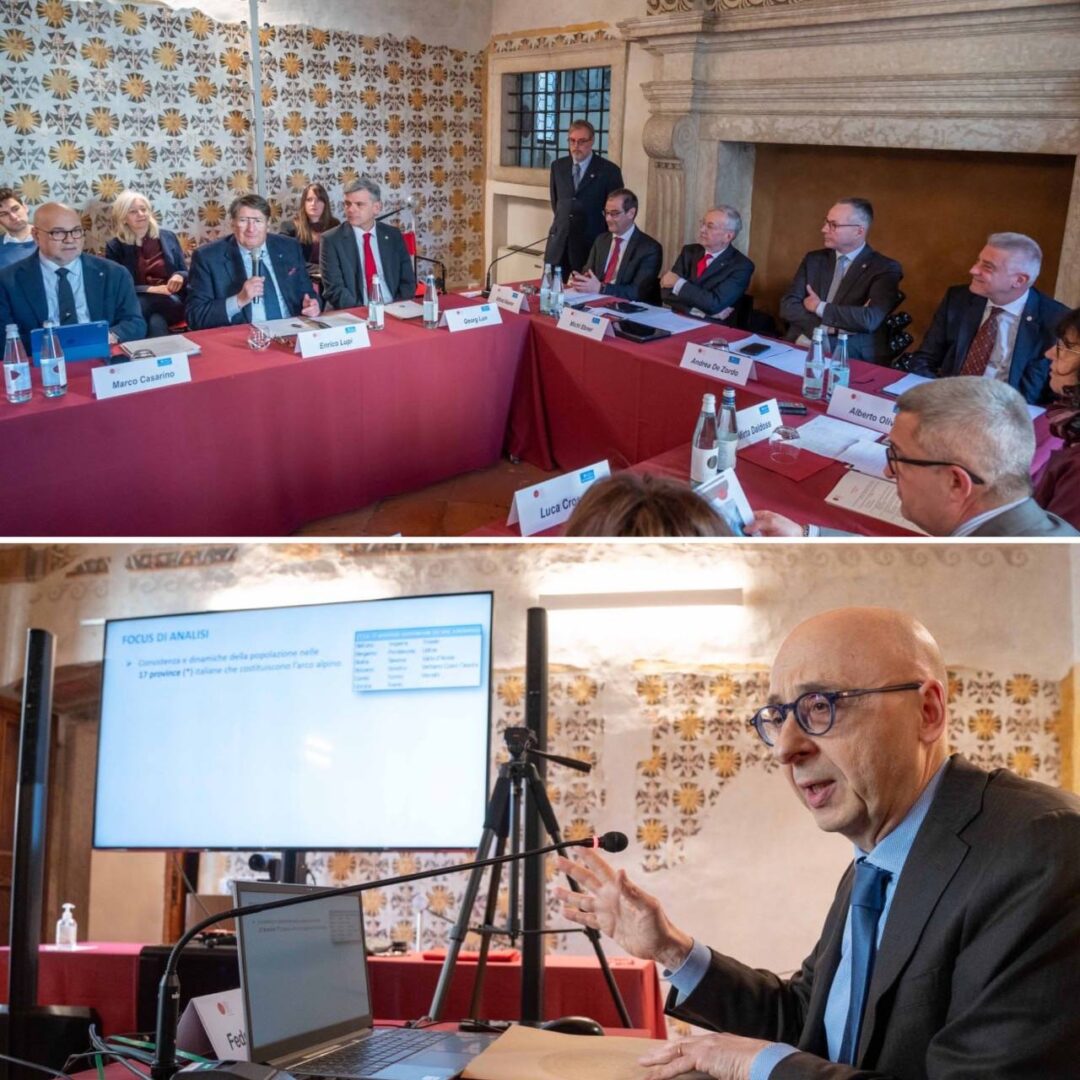
During the morning, the Trento Chamber of Commerce hosted the first meeting of the year for Alps Benchmarking at Palazzo Roccabruna. This initiative promotes collaboration, dialogue, and exchange among the Chambers of Commerce of the Alpine region (Bolzano, Cuneo, Monte Rosa Laghi Alto Piemonte, Pordenone-Udine, Riviere di Liguria Imperia La Spezia Savona, Sondrio, Turin, Trento, Treviso-Belluno, Valle d’Aosta, Venezia Giulia Trieste Gorizia, together with Unioncamere Lombardia and Unioncamere Piemonte).
The relaunch of the initiative, proposed by the South Tyrolean Chamber of Commerce, draws on previous experiences of collaboration among the Chambers of the Alpine Arc and focuses its efforts on discussing issues of common interest and sharing studies and analyses useful for the development of mountain regions. Following the opening remarks by Andrea De Zordo and Michl Ebner, respectively President of the Trento Chamber of Commerce and the Bolzano Chamber of Commerce, Alfred Aberer, Secretary General of the South Tyrolean Chamber of Commerce, outlined the new Alps Benchmarking agreement, which commits the Chambers of Commerce and Regional Unions of the Alpine Arc to a common goal: “the promotion of a business-friendly economic policy, the enhancement of collaboration among businesses, and networking activities aimed at supporting the economic development of their respective mountain regions”.
The Alps Benchmarking Agreement – commented Andrea De Zordo, President of the Trento Chamber of Commerce – is an interesting tool for collaboration among Alpine regions that will allow us to strengthen related economic networks, build critical mass, and carry more weight at the European level. Furthermore, it will facilitate the sharing of statistical data and economic development models, promote training, engage with national and European policymakers, and exchange best practices with foreign Chambers of Commerce active in neighboring regions. I believe today’s signing is an important testament to how ‘networking’ and exchange between institutions can multiply the energy supporting territorial development, thereby enhancing its results.
The discussion then turned to an in-depth examination of the topic chosen for this first meeting of the year, which focused on demographic trends among the population and businesses in the Alpine regions. Thanks to the in-depth analyses conducted by the respective research departments of the participating Chambers of Commerce, it was possible to outline a comprehensive picture that highlighted the need to respond to current trends in order to counter the demographic decline in the Alpine regions.
Following a brief introduction by Massimo Pavanelli (Trento Chamber of Commerce), who explained the methodological approach adopted and shared by colleagues from the Chambers of Commerce for the studies presented that morning, Federico Callegari (Treviso-Belluno Chamber of Commerce) explored the distribution and dynamics of the resident population in the Italian territories of the Alpine Arc, broken down by orographic areas and accessibility indices. His presentation highlighted how the challenge of depopulation in the highlands can be mitigated through – initiatives to attract young people and enhance housing availability, especially in those areas where intense tourism exacerbates the shortage of housing due to the phenomenon of short-term rentals.
Roberto Saletti (Turin Chamber of Commerce) then provided an overview of the evolution of the business landscape in the Alpine region, drawing on interesting insights from the chamber’s archives. –Traditional sectors of the mountain economy are in decline; agriculture, despite many difficulties, remains a fundamental pillar, while services and tourism are growing. The Alpine region is, however, an area with enormous potential, but to fully realize it, it needs to be supported by targeted policies, adequate services, and structural investments that reduce disparities and enhance its unique characteristics.
Linda Giugovaz (Venezia Giulia Chamber of Commerce) then outlined the demographic structure and entrepreneurial dynamics in Venezia Giulia, presenting empirical evidence and pathways to resilience. The final presentation, delivered by Matteo Degasperi (Trento Chamber of Commerce), focused on the tools needed to address mountain depopulation, proposing a classification of interventions based on integration and flexibility. – The strategy moves beyond the logic of standardized solutions to adopt an approach that takes into account the unique characteristics of the local area, centering on an initiative based on six pillars: the revitalization of housing, the enhancement of local services, digital connectivity, the social role of schools, the attraction of new talent, and the development of local supply chains to ensure economic sustainability.
Photo essay: Daniele Panato
Trento, March 3, 2026