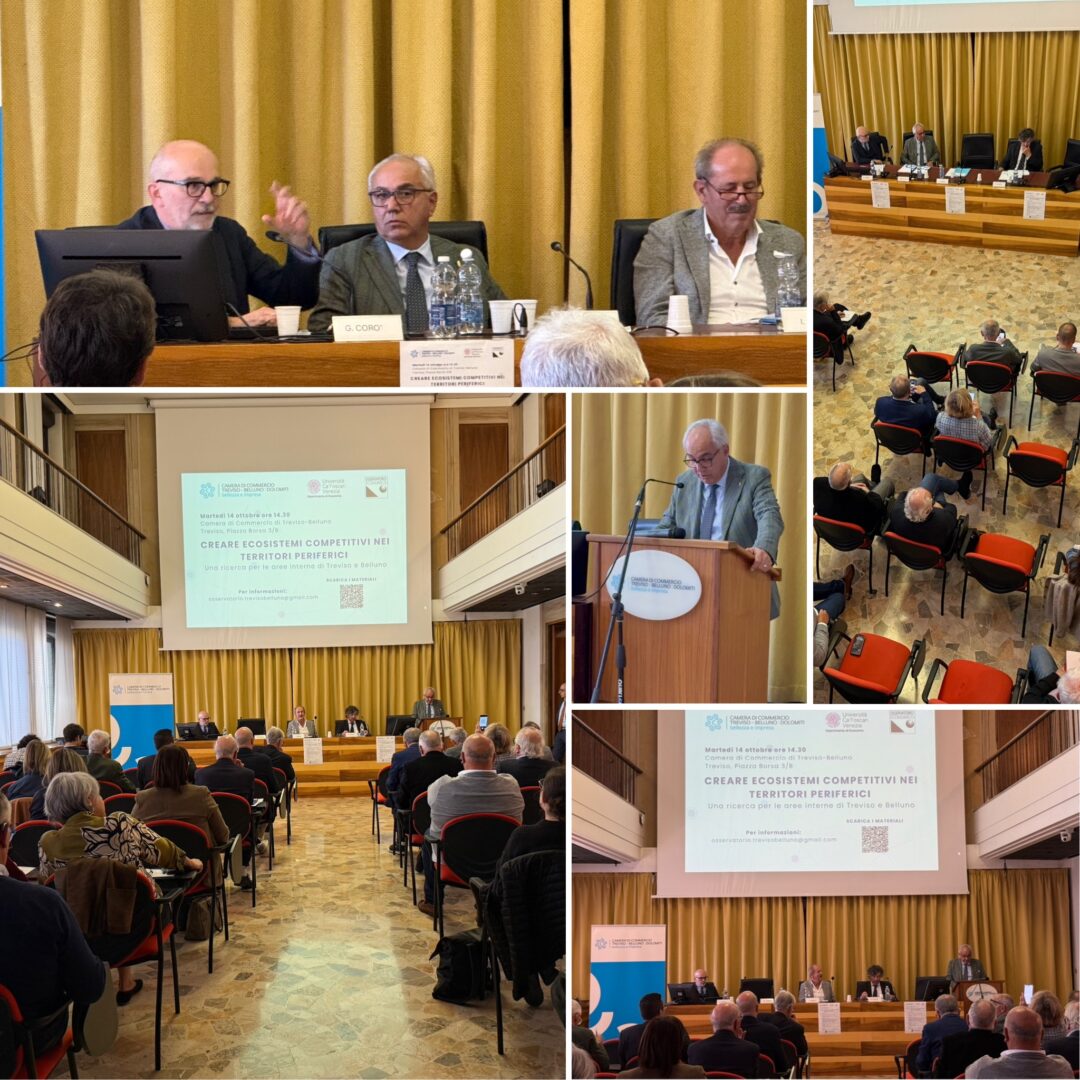
Treviso, Tuesday, October 14 – In the afternoon, a conference was held at the Chamber of Commerce, during which the results of an important study carried out by the Economic Observatory were presented, with scientific support from Ca’ Foscari University of Venice and financial contribution from the Chamber of Commerce itself.
The initial question that the research sought to answer is reflected in the title of the conference: under what conditions can we “create competitive ecosystems in peripheral areas”? This is an urgent question, which takes shape in light of three trends.
The first is that the gap between attractive areas, particularly major metropolitan centers, and peripheral regions, including those that were once leaders in manufacturing development, is widening. Peripherality, exacerbated by demographic dynamics, is a risk factor that currently affects some inland areas of Veneto, particularly in the Belluno mountains, but could spread to other areas of the region.
The second: manufacturing, while still important, is no longer sufficient on its own to ensure future development and good employment. The traditional “know-how” of industrial districts risks being displaced by the ongoing technological acceleration, leaving the territory with reduced added value, while leading companies position intangible and more profitable services—research, design, marketing, finance—in metropolitan centers, attracting talent and foreign investment. This also leads to a distortion of the labor market towards operational tasks that young people no longer want to do.
Thirdly, although tourism is a growing sector, it is not capable of reviving the development of inland areas on its own. While tourism is mainly a low value-added activity, it also contributes to creating pressure on the prices of essential goods, primarily housing, as shown by the phenomena of overtourism and short-term rentals, generating potential conflicts with resident communities.
Starting from these considerations, the conference sought to identify the conditions for creating ‘competitive ecosystems’ in inland areas, leveraging certain factors necessary to increase added value and make jobs more attractive to young people.
Based on information gathered from the most active players in the region and on the basis of a number of successful national and international experiences, the conference focused in particular on five key factors for an industrial policy for inland areas:
- innovation in existing production chains, encouraging the development of services, technologies, and new business models;
- selective attraction of foreign investment, also with a view to promoting the growth of activities with a higher technological content;
- the central importance of technical and polytechnic training; university education, creating closer links with the demand for new productive knowledge from businesses and territories;
- local finance geared towards development and innovation, with the aim of promoting the regeneration of the entrepreneurial fabric, encouraging a more active role for larger companies (corporate entrepreneurship);
- the development of urban service networks and a residential policy aimed at workers and students.
Comment by Mario Pozza, President of the Treviso and Belluno | Dolomites Chamber of Commerce
It was a research project lasting almost two years, based in part on extensive consultation with businesses in our region, both large and small, and with leading business associations, comments Mario Pozza, President of the Treviso and Belluno Chamber of Commerce | Dolomites. The various elements gathered are summarized in this conference which, adds Pozza, already poses a very challenging but necessary challenge in its title in order to keep pace with the changes taking place in the global scenario.
Of course, continues Pozza, it is difficult to think that a development model that has ensured our success and prosperity for forty years is at risk. But this is the task of those who do research. To foresee scenarios. To identify threats and opportunities. It is not a question of denying our past, our excellence. However, we need to understand which factors to act on in order to make the most of them. And at the same time, we need to understand what to change. In good time, with courage. In discontinuity with the past, with the dangerous temptation to be satisfied with our past. At all levels: from businesses to intermediary bodies that facilitate development to institutions.
I believe this is the most important legacy of the research and the conference- concludes Pozza. With a series of issues that I believe should remain on the agenda. Given the high level of discussion at the round table with representatives of regional trade associations. To do the things we do better, bringing them into the system more effectively. To do new things. And to have an important basis for discussion and guidance for what will be the new regional administrative cycle.
Comment by Ivo Nardi, president of the Treviso and Belluno Economic and Social Observatory
As an entrepreneur even before being president of the Observatory, I am very pleased to present a study that not only raises awareness of global scenarios and their impact on our territories, but also provides guidelines for taking concrete action to manage the necessary change. This was the first comment by Ivo Nardi, president of the Treviso and Belluno Economic and Social Observatory, the body that coordinated the study.
But this is not something we have imposed from above- Nardi immediately points out-because the research findings are certainly based on desk analysis, but also on listening carefully to the territories.
President Nardi rattles off some important figures: we interviewed 30 leading companies in the provinces of Treviso and Belluno, half of which are multinationals. We held four focus groups, comparing almost 40 craft businesses, those in niches of excellence and those in the middle of the supply chains, which are experiencing changes with a whole series of inevitable asymmetries. We held five thematic workshops: on foreign investment, sustainable tourism, higher education, environmental services, and demographic forecasts for the next five to ten years, emphasizing the difficulty of finding personnel.
The agenda for this conference- concludes Nardi-is our attempt to present this large amount of data and reflections we have gathered. We have also enlisted the help of important guest speakers who have come to tell us about case histories that essentially say, ‘It can be done! Even here’.