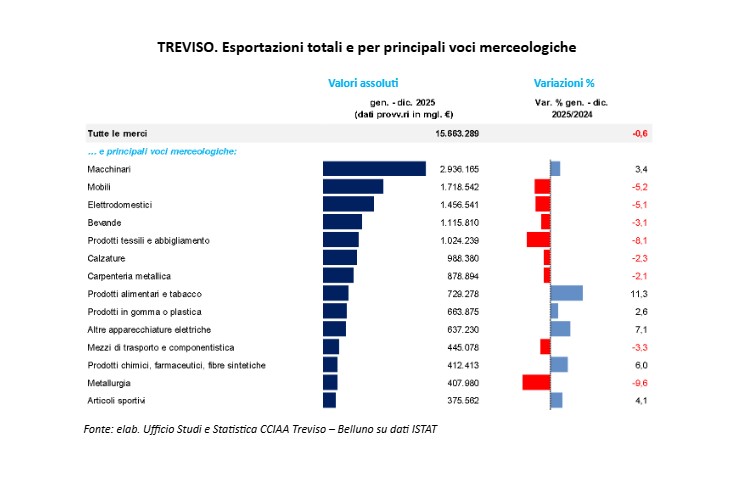
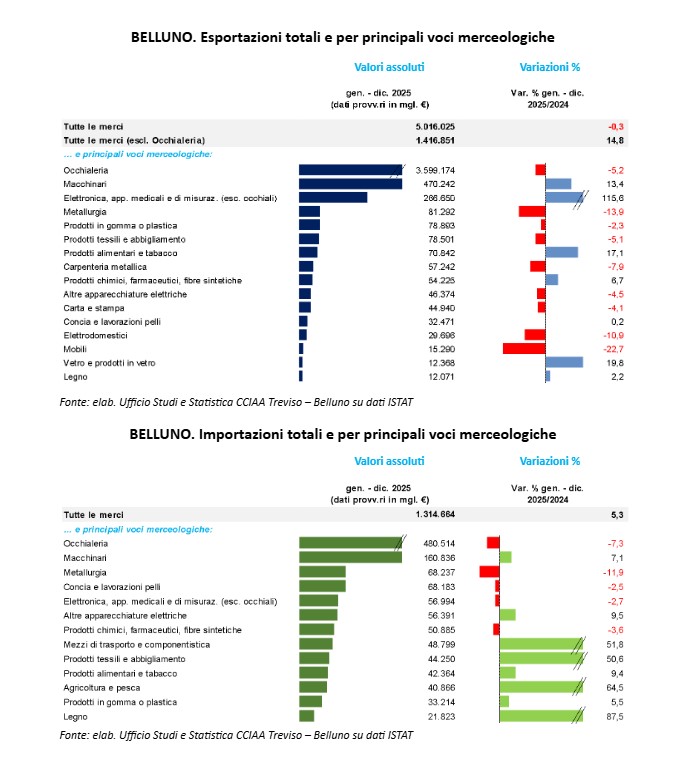
For Treviso, the year-over-year change is -0.6%; for Belluno, it is -0.3%.
Sales in the U.S. declined for both provinces, while EU markets are recovering.
Machinery sales showed positive growth for both Treviso (+3.4%) and Belluno (+13.4%).
Treviso, March 23, 2026
Comment by President Mario Pozza
According to data released by Istat, in 2025—comments Mario Pozza, President of the Treviso and Belluno|Dolomiti Chamber of Commerce—exports from the province of Treviso declined slightly by 0.6%. The decline is less severe than in the first nine months (when it stood at -1.2%) and confirms trends we had also observed in recent economic surveys. The companies surveyed indicated signs of recovery in orders from abroad specifically in the latter part of the year.
For Belluno — the President continues — exports are nearly flat (-0.3%). This result averages out the opposing trends of two major provincial sectors. Sales are down for the eyewear sector. The refrigeration sector, on the other hand, is driving exports of machinery and electronic equipment.
For both provinces, the decline in exports to the U.S. market is a major factor. For Treviso, the U.S. is the third-largest market by export value, accounting for 8% of total provincial exports. Sales fell by 8.1%, equivalent to a loss of 109 million euros. Nearly half of this decline is attributable to household appliances (-45 million, -56.8%), a figure easily linked to U.S. tariffs on steel. Fortunately, this decline in exports to the U.S. is partially offset by growth in other non-EU markets and by a substantial holding of ground within the EU. Fortunately, this decline in the U.S. is partially offset by growth in other non-EU markets and by a largely stable performance within the EU (-0.9%).
Sales in the US also declined for Prosecco (-6.6%, -€21 million): however, in this case, it is important to note the surge in demand that occurred in the first half of the year to avoid the impact of tariffs, which subsequently led to a market stalemate as the industry awaits the clearance of accumulated inventory.
Significant declines were also seen in the U.S. for the machinery sector (-13.4%, -€34 million), which is performing well overall, and for the furniture sector (-12.3%, -22 million euros), which is also struggling within the EU (-3.4%, mainly due to lower sales in the French, Spanish, and Polish markets, only partially offset by a recovery in the German market).
For Belluno, the United States is the primary export market: it accounts for nearly 600 million euros in exports, 12% of the provincial total. The decline in exports to the U.S. is driven by the eyewear sector. The drop for this sector is in the double digits: from 870 million euros in 2024 to nearly 525 million in 2025 (-39.9%). This corresponds to lost trade flows of over 295 million euros, a significant figure that points, as we have already noted in previous reports, to highly plausible redefinitions of the global value chain’s architecture – continues Pozza. – As a result of this reorganization, a historically significant portion of export volumes originating from the province of Belluno may have shifted to foreign-to-foreign flows (from Asian manufacturing countries to final consumer markets) or to production facilities located directly in the U.S. This is compounded by a drastic reduction in competitiveness in the U.S. market for smaller manufacturers with their own brands, due to tariffs.
It is nevertheless interesting to note – the President continues – how our companies have managed to offset the slowdown in the U.S. by expanding into new geographic markets. In both provinces, double-digit growth stands out in particular for exports to Mexico and the United Arab Emirates—the latter serving as a logistics hub for the Middle East, now at the center of new conflict scenarios. Exports from Treviso to India are growing (+45.7%, +48 million). Added to this are signs of a recovery in the EU market: exports to Germany (+2.8% for Treviso and +9.0% for Belluno) and France (+3.4% for Treviso and +8.2% for Belluno) are rebounding in particular.
Looking at the sectors, I highlight the resilience of machinery (+3.4% in Treviso and +13.4% in Belluno) with a geographic diversification of markets affecting both provinces. This is a sign that, despite the uncertainty (or perhaps because of it), there has still been room for growth for our companies offering customized industrial plant solutions around the world. In addition to those components of the mechanical engineering industry now activated by the expanded defense supply chain.
In the current climate, diversification is more necessary than ever. And we have been promoting this process for some time now – concludes Pozza, also in his capacity as President of Assocamerestero. – I have just returned from a mission to Australia, which, in addition to fostering trade with this market, laid the groundwork for the Southeast Asia Forum that the Treviso-Belluno|Dolomiti Chamber of Commerce will host in mid-June in Treviso, specifically to open new business avenues for our companies toward one of the regions with the greatest potential for global growth.
The National and Regional Picture
In 2025, according to data released by Istat, the value of national exports increased by 3.3% compared to the previous year. A similar trend is observed for imports, which grew by 3.2% over the same period.
The trend in national exports reflects highly varied market dynamics.
Exports to the European Union increased by 4.2%, with widespread growth among the main economic partners. Spain stands out in particular; as noted in previous reports, it is proving to be an extremely dynamic market, with double-digit growth in national exports (+10.6%). Exports are also recovering to Germany (+2.4%) and France (+5.3%).
Outside the European Union, the value of exports rose by 2.4%. This result reflects an average of export growth to the United States (+7.2%, driven mainly by shipbuilding and pharmaceuticals) and to the United Arab Emirates (+19.7%) and India (+9.4%), alongside a decline, particularly to China and Hong Kong (-6.5%), Turkey (-23.1%), and Mexico (-9.8%).
As for regional trends, national exports benefited primarily from the positive performance of central regions, particularly Lazio (+9.6%) and Tuscany (+21.3%), both driven by higher sales of pharmaceutical, chemical, medicinal, and botanical products, with gold jewelry adding to the growth in Tuscany.
For the Northeast, the slight increase (+2.0%) incorporates the exceptional result of Friuli-Venezia Giulia (+17.8%), attributable to shipbuilding.
For the Veneto region, the overall picture for exports remains essentially stable (-0.2%). Here too, this is an average result, reflecting the resilience of the food and machinery sectors. Beverage exports are also essentially stable (+0.5%), but this figure includes a decline in Treviso’s Prosecco (-3.1%) and a slight decrease in the Verona sector (-0.9%). On the other hand, difficulties persist for footwear (-7.4%) and leather tanning (-5.1%). Eyewear and furniture are also down.
Geographically, the European Union is driving Veneto’s exports (+2.1%). Standout performances include exports to Spain (+7.0%) and Poland (+7.8%), but traditional markets are also recovering, with moderate growth in France (+2.3%) and Germany (+1.1%). Outside the European Union, sales fell by -3.4%, penalized mainly by the United Kingdom (-15.6%, attributable to shipbuilding) and the United States (-6.4%). Several sectors contributed to the contraction of the U.S. market, starting with eyewear. The decline was also seen in exports of furniture, machinery, and household appliances. As for beverages, the drop reflects a period of adjustment: following the rush to purchase in the early months of the year to anticipate the introduction of tariffs, the U.S. market is now in the process of clearing accumulated inventory.
Exports from Veneto to China and Hong Kong also fell by 11.7%. Finally, the United Arab Emirates (+15.3%) and India (+24.4%) stand out for bucking the trend with double-digit growth.
Trade in the Province of Treviso
For the Province of Treviso, the year closed with exports totaling nearly €15.7 billion, a slight decrease of 0.6% compared to 2024. This result, an improvement over the -1.2% recorded in the first nine months, reflects trends also revealed by economic surveys: the sample of manufacturing firms reported, in fact, a recovery in orders from abroad in the latter part of the year.
The data highlight a province that has managed to offset the slowdown in key markets such as the U.S. (-8.1%, which particularly affected household appliances, beverages, machinery, furniture, and sporting goods) by tapping into new geographic markets. Particularly notable is the double-digit growth toward Mexico, India, and the United Arab Emirates, the latter serving as a logistics hub for the Middle East, now at the center of new war scenarios. At the same time, there was a slight increase of +1.0% in the European Union market, driven by the recovery in France (+3.4%) and Germany (+2.8%), as well as the consolidation of Spain (+2.0%) and Poland (+2.5%), markets that are increasingly receptive to exports from Treviso.
Looking at the various sectors, the annual report highlights the province’s exports of industrial machinery, food products, electrical equipment, chemicals, electronics, and sporting goods: sales in all these sectors are up compared to the previous year. On the other hand, products related to the home sector (furniture and appliances), textiles and apparel, and automotive components are declining. Sales of beverages and footwear are also down.
For the main sectors, the findings from the market analysis are reported below.
Machinery exports rebound (+3.4%)
This category remains the top export by value for the province. Overseas sales of machinery saw an annual increase of +3.4%, whereas they had remained virtually flat when comparing 2024 to 2023. Within the European Union, demand has rebounded notably in Germany (+12.3%) and France (+8.3%), accompanied by excellent performance in Spain (+11.9%) and Austria (+20.4%). Outside the European Union, the most significant increases were observed in the United Arab Emirates, which more than doubled demand (+141%), and in India (+50.9%) and Mexico (+47.3%), which are establishing themselves as strategic partners in machinery purchases. The negative note comes from the United States, which recorded a decline of -13.4%, suffering from the uncertainty linked to protectionist policies.
Contrasting trends for food (+11.3%) and beverages (-3.1%)
The food and beverage sectors experienced contrasting export trends in 2025: compared to 2024, food exports increased by +11.3%, while beverage sales (primarily Prosecco) declined by -3.1%, following a first half of the year marked by growth (+10.8%) driven by the aforementioned phenomenon of front-loaded demand.
For the food sector, which proved to be the province’s most dynamic sector, sales intensified particularly within the European Union, driven by France (+35.8%), but double-digit growth was widespread across most of the region’s major markets. Exports, on the other hand, are down to the non-EU27 area (-5.7%), but not this time due to the U.S., where Treviso food products grew by +10.8%. Sales growth in the United Kingdom was also significant (+28.2%).
Overall, the sector’s exports are driven, in particular, by coffee (and a price effect due to rising raw material costs likely plays a role), fresh pasta products, frozen foods, dairy products, and preserved/processed meats.
As for beverages, however, following the growth of recent years, the provincial sector (primarily Prosecco) is experiencing a decline in exports. The performance over the past year has been weighed down primarily by the downturn in the U.S. market, which is the largest by value. Sales to the United States have dropped from €310 million in 2024 to the current €290 million (-6.6%), a decline primarily linked to the management of inventory accumulated in previous periods due to the introduction of tariffs. Exports to Canada are also down (from €47.3 million to €35.9 million; -24.0%). Exports, on the other hand, are recovering to the United Kingdom (+5.1%) and France (+12.2%).
For the Sportsystem, footwear remains down (-2.3%), while sporting goods are up (+4.1%)
A contrasting trend is observed for the Sportsystem sector: its supply chain saw a decline in footwear exports (-2.3%), though this was less severe than the sharply negative result recorded in 2024 (-13.5%), while sports goods grew by +4.1%.
Sales of athletic footwear are declining both to the European Union—the main export market, accounting for 70% of total exports, with a drop of -1.6%—and to markets outside the EU-27 (-4.0%). In both regions, the decline is widespread across most markets. Notably, Germany, one of the main markets, saw a further decline of -3.2%, though this was less severe than the sharp -21.0% drop of the previous year. Bucking the trend, France (+9.8%) and the United States (+12.4%) posted positive growth. For the U.S. market, the figure reflects a gradual stabilization following the +31.7% surge in the first half of the year, a sign of demand concentrated in the first half due to fears of tariffs.
As for sporting goods, exports grew thanks to European demand (+10.6%, compared to -5.2% the previous year). In addition to the recoveries in the French (+10.3%) and Austrian (+9.8%) markets and the consolidation of the German market (+7.4%), double-digit growth was observed in exports to Poland, the Netherlands, and Spain. The 4.6% decline in sales to the non-EU27 area is primarily driven by the U.S. market (-9.4%, attributable to the drop in exports in the second half of the year). The decline in exports to the U.S. is partially offset by the Canadian and Swiss markets, along with exponential growth in the United Arab Emirates, albeit at volumes that remain niche.
For the Home Furnishings Sector, furniture (-5.2%) and household appliances (-5.1%) are down
Provincial exports of furniture and household appliances have seen a similar decline: -5.2% for the former and -5.1% for the latter.
More than half of the overall decline in furniture exports is attributable to the top two markets within the EU-27 and outside the EU-27. Sales to France fell from 353 million in 2024 to the current 324 million (-8.0%). In the United States, the new protectionist policy is having an impact: the value of exports has dropped from 175 million to the current 154 million (-12.3%, corresponding to a shortfall of 21.3 million compared to 2024).
Despite the overall decline, however, Treviso-based furniture manufacturers are seeing a partial recovery in the German (+3.6%) and Russian (+31.5%) markets. Finally, furniture exports to Canada are consolidating (+25.6%).
The home appliances sector is primarily suffering from the contraction of the U.S. market. Sales to the U.S. have more than halved: from 80 million euros in 2024 to the current 34.4 million euros (-56.8%, representing a shortfall of over 45 million euros). However, to partially offset this, there has been significant export growth to other non-EU markets, particularly in the Arab and Middle Eastern regions. Exports to the EU remained largely stable (-0.9%), with very positive performance in France (+25.2%) and a slight recovery in Germany (+2.4%), but also significant declines in Spain (-21.4%) and Austria (-31.8%).
Fashion and Automotive Sectors Still in Decline
The textile and apparel sector is facing the greatest difficulties (-8.1%), with widespread export declines almost everywhere (Germany -16.0%, France -12.9%). Romania (a production hub) stands out as a positive exception.
Exports in the automotive sector are still down by 3.3%, though this decline is less severe than the 11.0% drop recorded the previous year. The decline in Treviso-based automotive components is largely due to a drop in exports to non-EU27 countries (-6.6%) and, in particular, to the UK market (-32.5%). For the European Union, the decline in sales is -1.8%, driven by the crisis in the German (-6.2%) and French (-7.2%) sectors. However, there is a striking positive trend toward Spain (+39.2%), which is becoming an increasingly important market.
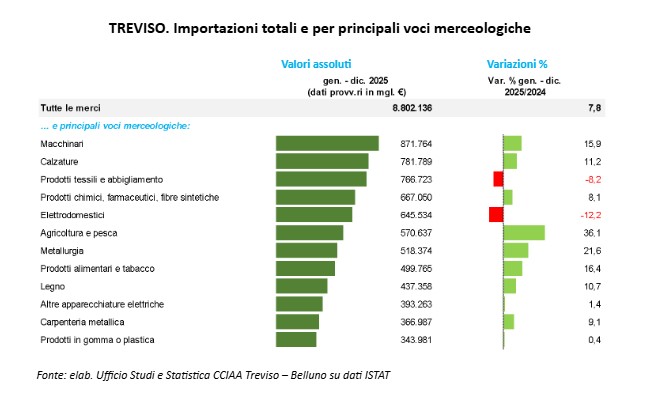
Purchases from abroad by Treviso-based companies in 2025 amounted to 8.8 billion euros, an increase of 7.8% compared to the same period the previous year.