Economy - published on 19 February 2024
Source: osservatorio economico Treviso Belluno
Treviso, Feb. 16. The Economic Social Observatory of Treviso and Belluno has conducted research on population projections to 2031 in the provinces of Treviso and Belluno. The goal is to understand what the differential effects of these projections will be in different municipalities, with what impacts on school planning, the labor market, and services for the elderly.
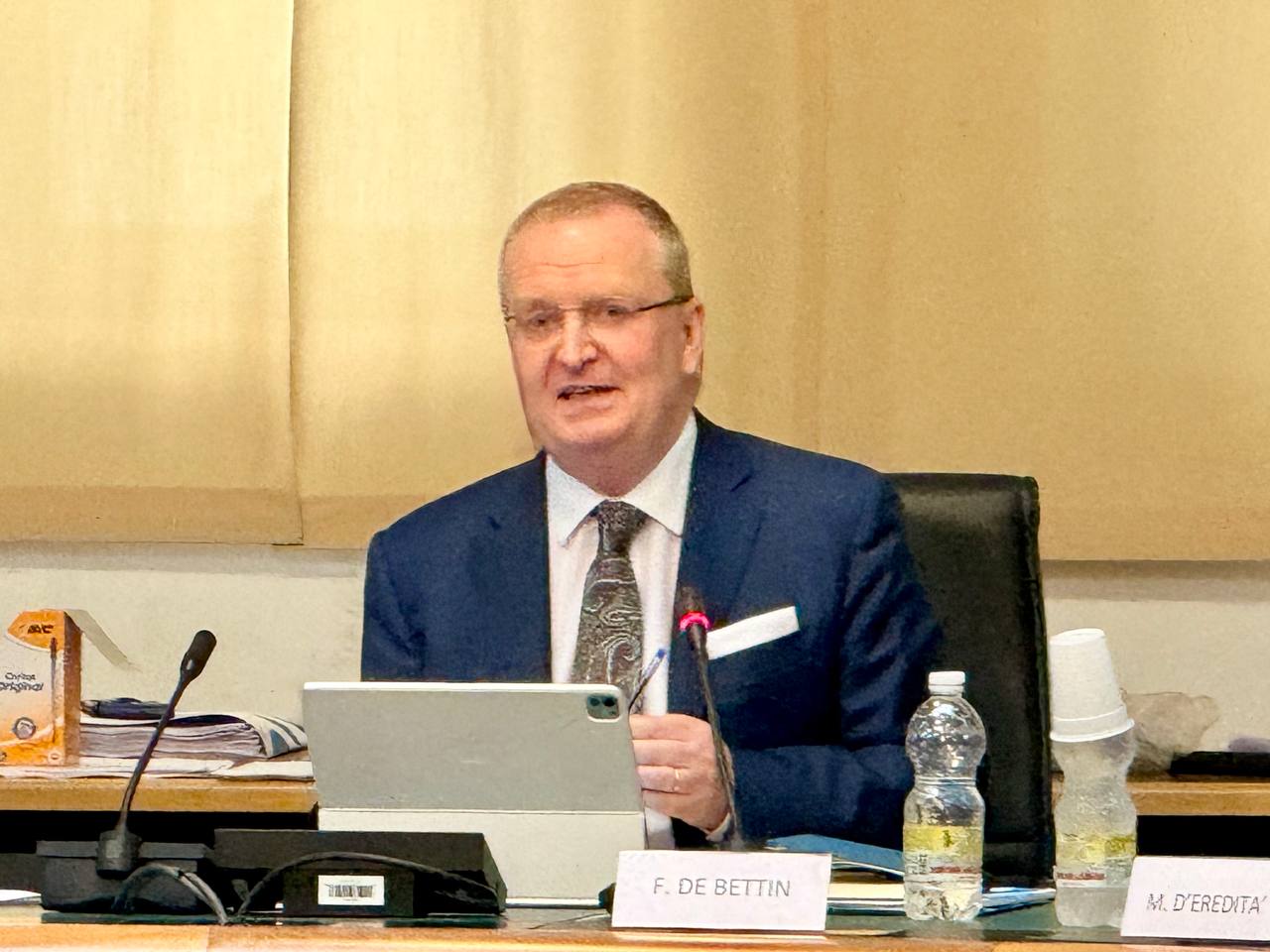
Author of the study, statistician Andrea Mamprin. As discussants, speakers included Barbara Sardella, Veneto Regional School Office, manager of the Treviso Area Office; Rina Camporese, Istat; Letizia Bertazzon, Labor Market Observatory, Veneto Lavoro; and Gianpiero Dalla Zuanna, full professor of demography at the University of Padua.
Institutional greetings were given by Elena Donazzan, Councillor for Education, Training, Employment, Equal Opportunities, Veneto Region; and the deputy mayor of the municipality of Treviso, Alessandro Manera. Mario Pozza, President of the Treviso-Belluno Chamber of Commerce, and Ivo Nardi, President of the Economic Observatory, did the honors.
Not as of today, the transformations in the age structure of the population and the demographic imbalances present in the various territories of the Veneto region are posing a series of questions related to the sustainability of certain dynamics (think, first and foremost, of the labor market) or at least to changes in certain essential services (schools, the elderly). These changes become even more evident if we try to project current trends into the near future.
Should current trends continue, the regional population as of 2031 is expected to stand at 4.824 million, or about 46,000 people less than in 2021. In ten years, this is like Bassano del Grappa disappearing, or two important centers such as Oderzo and Vittorio Veneto. But the balance would be far more dramatic if a projection were considered in the absence of migration flows: -190,000 inhabitants would be lost in Veneto, almost the sum of the inhabitants of the cities of Vicenza and Treviso.
The first message is clear. We manage to contain the damage of the “demographic winter” only thanks to the migration balance, especially the foreign migration balance. With flows that at this point will have to be intelligently managed, functional for employment inclusion.
How will things go in the province of Treviso? According to projections prepared by the Observatory, the province may lose 4,800 inhabitants between now and 2031, a contraction that could be -27,000 residents in the absence of migration flows.
Remaining with the hypothesis compensated by the migration balance, however, it must be said that this decline will not be equally distributed throughout the territory. The areas that will suffer the most from the population decline will be the area of Vittorio Veneto (-3.3% over the 2021-2031 decade) and the Conegliano area (-2.3%). While only “greater Treviso” will still be in a situation of moderate expansion in population numbers (+1.1%).
The first, tangible, effects of these demographic dynamics are the decline in the number of children (also due to fewer cohorts of mothers of childbearing age) and the increase in the elderly population (more longevity, overall, and transit of the most populous generation of so-called “boomers” toward retirement ages).
Childcare services (0-2 years) will experience the paradox of progressively better coverage rates due to shrinking birth cohorts (-3,100 babies 0-2 years in the period 2021-2031 in the province of Treviso). Today, the supply of daycare places “barely” covers 32% of potential need. With unchanged supply of services, a potential coverage of 38% could be reached in 2031. And 1,000 more daycare places in the province would be enough to reach the European target of 45%.
But already in elementary school the story will be very different. In the province of Treviso, from 2021 to 2031, the population of students in the 6-10 age group will shrink by about 9,200. A decrease that, inevitably, will have to lead to the overcoming of the current criteria for class formation and the adoption of educational and organizational innovations, if we want to avoid as much as possible the cutting of plexuses, especially in small communities. Another -5,700 students will affect the 11-13 age group, that of middle schools.
As for the elderly, in Marca Trevigiana the incidence of the over-65s in the total population will rise from 17.3 percent in 2001 to 27.7% in 2031. In absolute values, this means that we will go from about 136,700 to about 242,300 over-65s (+105 thousand). In the same proportion, we have to imagine an increase in the pressure on health and social welfare services, with all that this implies in terms of supply retention. In the Victorian area, almost one in three people will be over 65.
In the midst of denatality and aging lies the functioning of the labor market, which will also have to encounter new balances. From 2021 to 2031 regionally there will be about 150,000 fewer residents of working age. This projection leads to outline, for the Treviso labor market, a potential shortfall of 23,200 working-age residents. But the additional phenomenon to consider is the different composition by educational qualifications of the cohorts exiting and entering the labor market. As is physiological to expect, the outgoing cohorts are, on average, less educated than the young people entering the labor market.To give a number: the graduation rate among those employed in the 60-64 year-old cohort as of 2022 is 17.3%, which doubles with reference to the 25-29 year-old cohort (35.9%).
This foreshadows a double level of employment mismatching: quantitative, on the objective basis of the lower stock of working-age residents; and qualitative, on the basis of the recomposition by educational qualifications of the working population, with inevitable different professional expectations, increasingly less compatible with the most basic segments of labor demand (according to the Unioncamere-Excelsior survey, still in 2023 14.1% of planned hires in the province of Treviso, about 11,400 in absolute values, involved unskilled professions).
COMMENTS
Mario Pozza – President of the Treviso-Belluno Chamber of Commerce|Dolomites
“This research on the demographic projections to 2031 in our territories provides us with important numbers, which force us to define new hypotheses of the future for our community – is the first hot comment of the President of the Treviso-Belluno|Dolomiti Chamber of Commerce, Mario Pozza.
“In the province of Treviso, between 2021 and 2031, businesses will lack 23,000 working-age residents. It will therefore worsen the already difficult process of labor force recruitment by companies, in the short term compensable – according to President Pozza – by an intelligent management of migration flows, as we are trying to do with the Prefecture of Treviso, and by raising the female employment rate.”
“But – he immediately adds – in a medium- to long-term vision, we will have to redefine, in companies and territories, the conditions for attracting young talent. Few and more qualified. That it is not true that they do not want to work: in reality they are asking to be better valued, in terms of roles, salaries, careers, also for the social and cultural environment we can offer them.”
President Pozza asks at this point, “Can social and health care withstand this shock wave, with unchanged supply of services? What levers do we have, including social innovation, to mitigate the damage, or better yet, even to radically rethink the logic of subsidiarity? You see: there are many questions that arise when wondering about demographic scenarios. This Economic Observatory research presented today is crucial, to understand that we are running out of time, that we must act. Otherwise, we will only suffer from these scenarios”
Ivo Nardi – President of the Economic Social Observatory of Treviso and Belluno
“As President of the Social Economic Observatory,” says President Ivo Nardi “I am particularly pleased with the feedback I received today at the end of the seminar on demographics, where institutions, trade associations, and trade union parties discussed a very important and current issue.
In this first part of my term of office” Nardi emphasized “there has been an in-depth dialogue with the 28 Institutions/Associations that adhere to the Observatory, true ‘sentinels’ of the world of work, schooling and society. From listening to them, the shoots of research projects were born. The first one I strongly wanted to focus on is today’s one on demographic analysis” Nardi continues “aware of its relevance to our communities.
The seminar offered an important stimulus for research and reflection on possible actions to be taken to counteract the demographic winter,” Nardi continued- We thank researcher Andrea Mamprin for his valuable research, as well as Barbara Sardella of the Veneto Regional School Office, Head of the Treviso Area Office, and Rina Camporese of ISTAT for their contribution focused on the school situation. Special thanks also go to Letizia Bertazzon, from Veneto Lavoro’s Labor Market Observatory, for her important focus on the world of work.
Finally, we are honored to have had as academic discussant Prof. Gianpiero Dalla Zuanna, full professor of Demography at the Department of Statistical Sciences, University of Padua. His speech, closing the research and other speakers’ presentations, gave great value to our seminar.
The Social Economic Observatory continues to be committed to analyzing and promoting initiatives aimed at understanding and addressing the demographic and socio-economic challenges of our communities – Nardi concludes – We will continue to work with determination to stimulate all stakeholders in the area for a better future.”