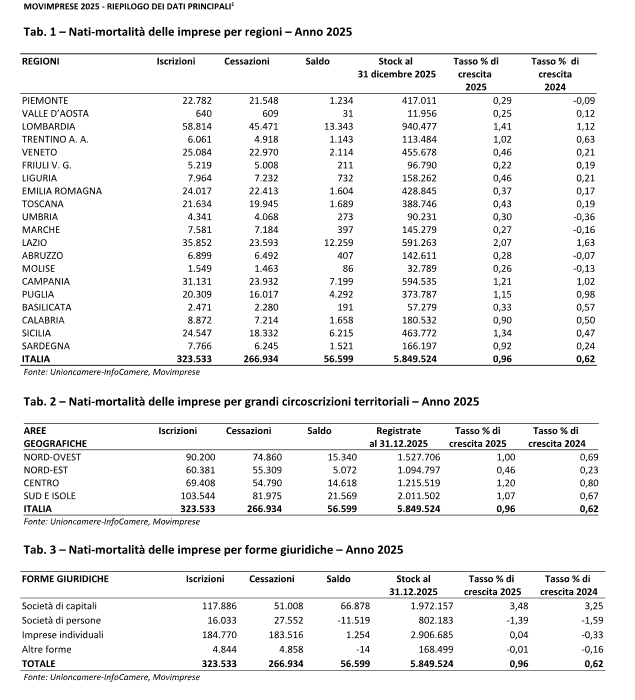
The Italian business system closes 2025 with a sign of vitality, recording a positive balance of 56,599 businesses. The figure reflects a 0.96% growth in stock, a result higher than both that of 2024 (+0.62%) and that of 2023 (+0.70%).
This strengthening of the productive base was determined by a combination of a substantial stability in new registrations (323,533 units, in line with 2024) and, above all, a significant contraction in the number of existing businesses ceasing trading, which fell to 266,934 units (-6.7% compared to the previous year). At the end of 2025, the total number of businesses registered in Italy stood at 5,849,524.
These are the main findings that emerge from the Movimprese data, processed by Unioncamere and InfoCamere on the basis of the Chambers of Commerce Business Register. The survey data is available at www.infocamere.it/movimprese.
The significant reduction in closures recorded in 2025 is a concrete sign of the resilience and endurance of the national production system – emphasizes Unioncamere President Andrea Prete – Movimprese data confirm the progressive downsizing of some traditional sectors, starting with agriculture and manufacturing, and the strengthening of the service economy, particularly financial, professional, and business support services, which are increasingly central to accompanying the development, innovation, and growth of the entrepreneurial fabric.
The sectors: the service economy and the energy boost
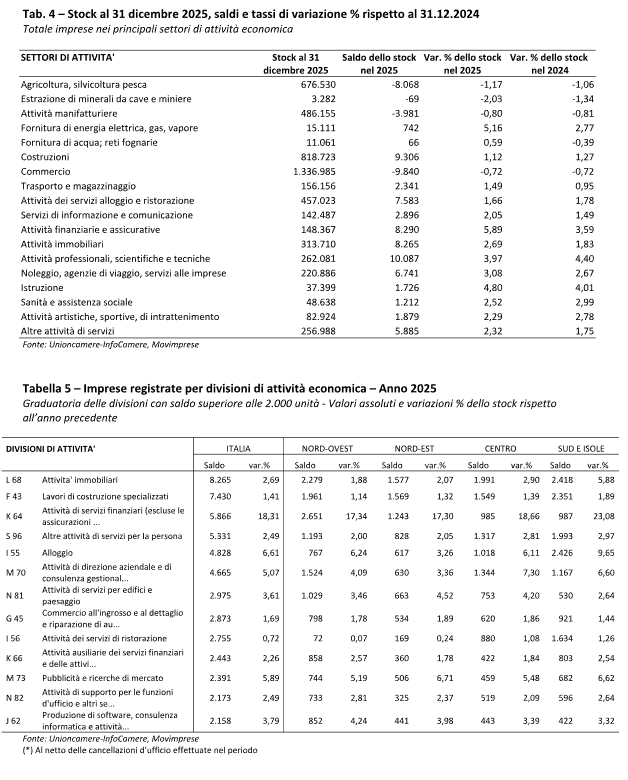
From a sectoral perspective, the highest growth rates were recorded in financial and insurance activities (+5.89%) and in the supply of electricity, gas, and steam (+5.16%). On the contrary, the downsizing of traditional sectors continues: agriculture lost over 8,000 businesses (-1.17%), trade fell by 9,840 units (-0.72%) and manufacturing activities decreased by 0.80% (-3,981 units). Construction remained strong, with a net increase of 9,306 businesses (+1.12%).
Looking at the individual economic divisions in detail, the analysis highlights a very clear growth hierarchy. The most significant contribution in absolute terms comes from real estate activities, which closed the year with a balance of 8,265 more companies (+2.69%), and specialized construction works (+7,430 units, equal to 1.41% growth).
The most striking performance in relative terms was in Financial Services (excluding insurance and pension funds), which recorded a jump of +18.31%, equal to 5,866 new businesses. This was followed by very strong growth rates in Accommodation (+6.61%), Advertising and market research (+5.89%) and Management consulting (+5.07%). Signs of strong momentum also came from the technology sector, with software production and IT consulting increasing its base by more than 2,100 units (+3.79%).
Legal forms: corporations remain the main driver of growth
Analysis by legal form reveals a two-speed system. The positive annual balance is entirely attributable to corporations, which increased by 66,878 units (+3.48%). Sole proprietorships returned to positive territory, albeit with a marginal increase (+1,254 units, equal to +0.04%), after the negative figure in 2024. Partnerships, on the other hand, continue to decline, losing over 11,500 units (-1.39%).
The balance sheet of the territories
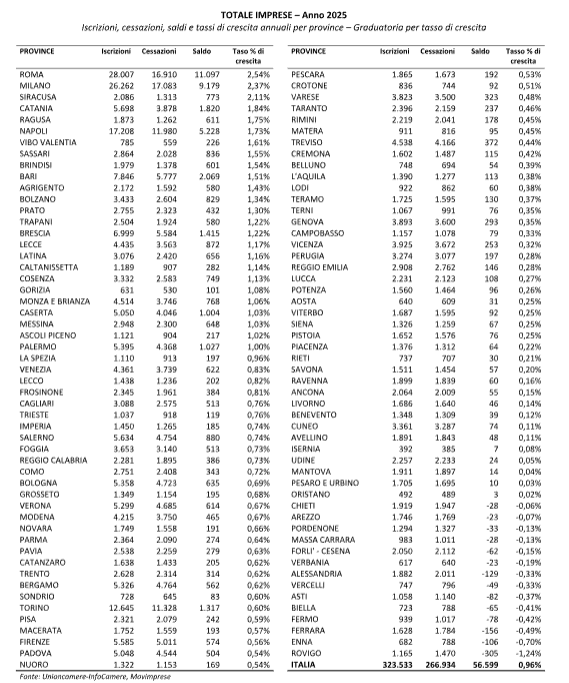
All macro-geographical areas closed the year with a positive sign. The most dynamic area was Central Italy (+1.20%), followed by Southern Italy and the Islands (+1.07%) and the North-West (+1.00%), while the North-East recorded the lowest growth (+0.46%). Among the regions, Lazio remains the most vibrant with a growth rate of 2.07% (+12,259 businesses), followed by Lombardy (+1.41%, equal to +13,343 units) and Sicily (+1.34%). At the provincial level, the best performances in terms of growth rate were in Rome (+2.54%), Milan (+2.37%), and Syracuse (+2.11%).