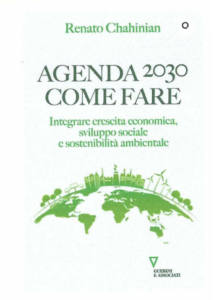
This is the title of the latest work by Roberto Chahinian, former Secretary General of our Chamber of Commerce and currently an expert in Sustainable Development Economics and Finance. He is also the curator of the “Investing in Treviso and Belluno” column for Treviso and Belluno System. The book, published by Guerini & Associati, has recently been released and is available for purchase both online and in bookstores. Given the significance and broad relevance of the subject of sustainable development, which now concerns individuals, organizations of all types, and the entire planet, we provide a brief summary of the book’s contents based on the introduction.
The work draws inspiration from Tommaso Moro’s famous book L’Utopia o la migliore forma di repubblica” (“Utopia, or The Best State of a Republic”), which, if applied to today’s world, would undoubtedly reference the principles of sustainable development for the greatest well-being of its citizens. The book imagines the actions taken and the benefits achieved in Utopia, which can be realized through this development model.
However, constructing a concrete, coherent system that maximizes the well-being of all is no simple task, as it requires integrating the 17 objectives outlined in the UN’s Agenda 2030 and other guidelines from various international institutions. Therefore, the actions needed can vary significantly in both scope and effectiveness. The primary aim of this book is to assess the importance of these objectives and highlight their key elements, in order to identify a set of concrete and coherent actions—some of which may be unconventional—that can be implemented by all stakeholders (citizens, businesses, non-profit organizations, and public entities). In doing so, it seeks to offer a profound impact in terms of long-term well-being for current and future generations, potentially exceeding even the goals of Agenda 2030.
This approach shifts the economic focus from profit maximization to the maximization of common well-being. In the long run, this, in turn, leads to the maximization of added value, which positively impacts all incomes, including lower wages and capital returns (which are initially sacrificed by the costs of the transition). Another key argument presented is that economic well-being is not sacrificed by social and environmental well-being; rather, these three dimensions are synergistic and mutually reinforcing—provided we identify the right actions among countless options that could sometimes be contradictory.
The overall system that emerges can serve as an example and guide for an optimal path, both by highlighting the most effective and achievable targets for an ideal society (which, under certain conditions, could become real) and by encouraging the emulation of partial virtuous actions (which still bring individual net benefits to all). Finally, it emphasizes that any current delay in action makes change more difficult and costly in the future.
Ultimately, the underlying requirement for embarking on such a path is the initial sacrifice needed for change, particularly in the productive activities of organizations. We must recognize that all of us are workers (even at the highest levels) and simultaneously benefit from productive improvements as consumers and citizens.
The actions and benefits outlined for Utopia, always conceived within a liberal and democratic system, are often compared in the book with the policies and failures observed in real-world countries, including advanced ones, which do not commit resolutely to the proposed sustainable development actions.
Implementing the many interventions described in Utopia does not constitute an “utopia,” as it might seem at first glance. All that is required is the conviction that sustainable development is the only path to our well-being, and the commitment of the majority to achieve it. For this to happen, a long period of maturation is needed, as it was in Utopia. However, the clear evidence of social and environmental harm we are facing, along with the widespread dissatisfaction with the current state of affairs, should significantly accelerate the change.
The main contents of the book include:
- The prologue, a fictional account where two young adults, precarious and struggling workers of our time, learn about the successes achieved on the mythical island of Utopia;
- A presentation of Utopia’s main physical and political characteristics, which are very similar to those of Italy but yield far superior sustainable results;
The fundamental prerequisites adopted to achieve all sustainable development goals; - The integration of the three dimensions (economic, social, and environmental) to maximize development;
- Innovative actions and objectives for achieving economic development;
- Actions and objectives guided by decent work to achieve social development;
- Climate and natural capital management actions and objectives for environmental development;
- Structure and organization of public institutions to effectively guide overall sustainable development;
- Main sustainable strategies at the territorial and sectoral levels;
- The management of change over time: from the birth of sustainability principles to their full realization;
- The epilogue of the fiction in which the two young protagonists find the well-being they desired in Utopia.
This book can appeal to a broad audience:
- Those involved in sustainable development will find in-depth discussions and non-traditional, synergistic topics;
- Those who support sustainability principles will gain a clear summary of the complex (but achievable) strategy needed to achieve satisfactory results;
- Finally, those who are agnostic or reluctant to commit to change will discover the many future benefits they stand to lose by maintaining their current stance.