Comment by President Mario Pozza
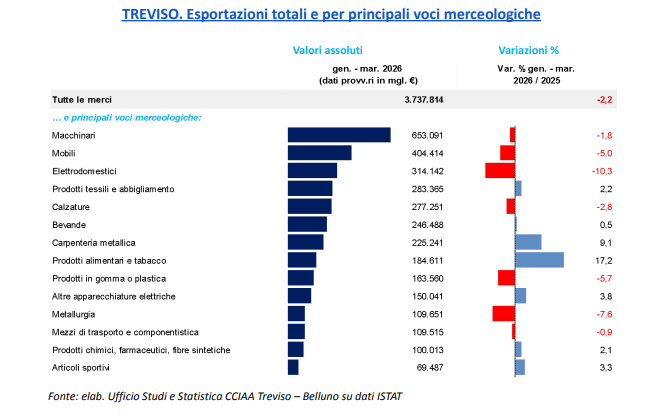
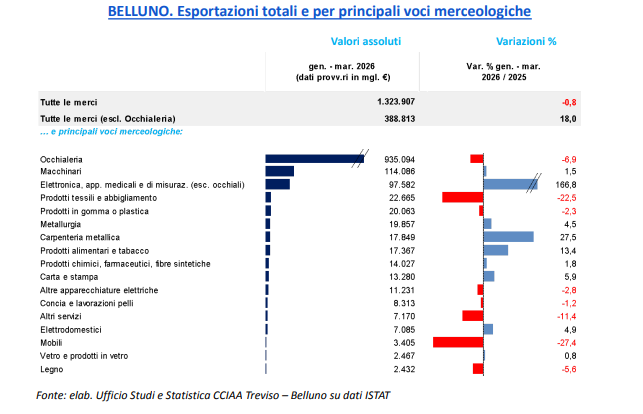
In the first quarter of 2026, according to data released by Istat, exports from the province of Treviso exceeded 3.7 billion euros, recording a slight year-over-year decline of -2.2% (approximately 84.2 million euros less than last year’s sales) – comments Mario Pozza, President of the Treviso and Belluno|Dolomiti Chamber of Commerce. – For Belluno, the result at the start of this year is nearly flat (-0.8%).
Looking at the data by sector – the President continues – we observe that a large part of the decline in Treviso’s exports is driven by household appliances, a sector that, as is well known, has been affected by specific corporate reorganizations: the change for the first quarter is -10.3% (meaning a decrease in exports of -36.1 million). The provincial figures are also affected by the decline in furniture (-5.0%; -21.3 million), a sector suffering not only from persistent weakness in global consumption but also from the impact of tariff barriers and geopolitical instability. Exports are down slightly for machinery (-1.8%; -11.9 million) and footwear (-2.8%; -8 million), but sporting goods buck the trend with a 3.3% increase.
Beverage exports, which for Treviso essentially mean Prosecco, remain virtually stable compared to last year (+0.5%). This figure, however, reflects the expected slowdown in the U.S. market. In the current quarter, exports to the U.S. are down by -7.3%; in the same period last year, due to front-loaded demand, sales had increased by +28.9%.
Food exports, on the other hand, continue to grow (+17.2%, equivalent to an increase of +27.1 million euros), with this positive trend extending to the Belluno area as well (+13.4%). In both provinces, the sector’s expansion involves both the European Union market, which accounts for three-quarters of sales, and the non-EU27 region.
For Belluno – as Pozza explains – the overall change in exports is nearly flat (-0.8%). However, this result reflects the average of the varying trends across the province’s main sectors. On the one hand, machinery remains steady (+1.5%), and the electronics, medical equipment, and measuring instruments sector is growing exponentially, with exports rising from 36.6 million euros in the first quarter of 2025 to the current 97.6 million. On the other hand, the eyewear sector has declined by -6.9%.
The decline in this sector is linked to a drop in sales to the United States, which fell by 34.5% year-over-year in the first quarter of 2026 (equivalent to a decrease of approximately 57 million euros). Beyond the structural reasons for the decline in exports, which have already been analyzed in previous reports, the current composition of provincial eyewear trade flows shows a contraction of the U.S. market: its share fell from 24.5% in the first quarter of 2024 to 11.5% in the first quarter of 2026 (equal to the share held by the French market).
Growth in electronics and medical equipment, on the other hand, is likely attributable to two factors: the evolution of the refrigeration sector toward greater integration with “smart” control systems, and the probable inclusion of “smart glasses” among customs codes referring to products with a strong electronic and connectivity component.
This – concludes Pozza, also in his role as President of Assocamerestero – is the overview that emerges from the data: a scenario in which the first effects of new geopolitical tensions and tariff barriers are also beginning to be felt. For this reason as well, it becomes essential for our companies not to rely on a single market but to diversify their export strategies, a process that we continue to encourage. A concrete example of this commitment was the SME Forum and the Southeast Asia Forum held in June at Castelbrando: strategic opportunities for dialogue, organized by the Treviso-Belluno|Dolomiti Chamber of Commerce in collaboration with Venicepromex, to guide businesses toward new opportunities for international growth.