I am deeply pleased – said Mario Pozza, President of the Chamber of Commerce – to have hosted this extraordinary event at our Chamber of Commerce: four days of meetings, reflection, and shared vision on ecology, beauty, and sustainability that have transformed the home of business into a place of authentic dialogue between cultures, knowledge, and responsibility.
I thank Dr. Cauteruccio for the high quality of the presentations by the distinguished international speakers and for bringing journalists from forty countries around the world to Treviso, who, through their professionalism, were able to lend depth and rigor to the questions on the most pressing issues of our time.
Moments of great intellectual emotion included the letter from the Holy Father read by His Excellency Bishop Tomasi of Treviso and the letter from His Eminence Cardinal Parolin read by His Eminence Cardinal Beniamino Stella. These moments imparted a spiritual and universal dimension to these days, reminding us that caring for the planet is first and foremost a shared moral responsibility.
To welcome and safeguard “the new humanity thirsting for the future,” we must understand and recognize the social and cultural value of biodiversity. From the 17th Greenaccord International Forum in Treviso comes a call for cooperation, innovation, and decarbonization.
Complexity not as a catalyst for vulnerability, but as a driver of unprecedented local opportunities for change. From the need for a systemic approach that brings together ecology, economics, sociology, and anthropology, to the role of beauty, art, poetry, music, and food as tools for connecting tradition and innovation, and humanity and nature: it is within this original and multifaceted experiential framework that the 17th International Forum on Information for the Safeguarding of Nature—which concluded this past weekend in Treviso—can be understood.
Within this framework, the role of culture and cultural venues—from museums to arts centers—also emerged strongly, not only as tools for education but as spaces capable of translating the complexity of the ecological transition into accessible and engaging experiences, fostering a more immediate and profound relationship between human needs and nature. A dimension that helps overcome the perception of sustainability as distant, costly, or complex, making it instead an integral part of daily life.
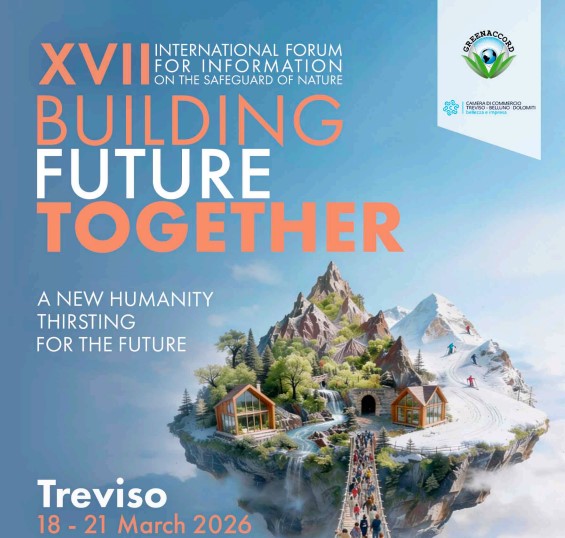
A hybrid, multidisciplinary, and cross-border initiative that goes beyond the purely technical or ideological aspects of sustainability to embrace a broader, more integrated vision of the future. For four days, the city became a veritable “global newsroom,” welcoming over 100 journalists from 40 countries, along with institutions, businesses, academics, and leading figures from the world of culture, gathered to discuss the theme “Building Future Together – A New Humanity Thirsting for the Future.”
This edition confirmed the Forum as one of the leading international platforms for dialogue between media, sustainability, and collective responsibility, placing the concept of integral ecology at the center as the key to addressing contemporary global challenges.
In this context, a central role was also assigned to cities, called upon to become concrete laboratories of transition through decarbonization processes, nature-based solutions, and the enhancement of ecosystem services. The contributions of architects, landscape architects, and local administrators highlighted how the quality of urban spaces and beauty can become strategic levers for the regeneration of territories and for the construction of more sustainable and inclusive development models.
Significant attention was also given to the relationship between health and the environment. In this context, the therapeutic value of nature came to the fore: from experiences of forest bathing—which demonstrate how contact with natural ecosystems promotes physical and mental well-being and contributes to quality of life—to the recognition of forests as true “healing systems” for both people and the planet.
At the same time, the Forum directly addressed the issue of eco-anxiety, which is increasingly widespread, especially among young people. It was emphasized that this condition represents an understandable response to the ongoing environmental crises and that, if properly supported, it can become a catalyst for awareness, participation, and collective action, preventing it from leading to paralysis or resignation.
Also of great significance is the international comparison between Europe and the United States, with particular reference to the dialogue between the Triveneto region and Colorado, which highlighted that companies investing in sustainability are more attractive to foreign markets and how different regions can share models of sustainable development, technological innovation, and environmental governance, thereby strengthening an increasingly strategic transatlantic partnership. This was further underscored by the presence of SACE, which supports companies and international exports by providing networks and assistance for internationalization processes, facilitating connections between foreign stakeholders and Italian companies, and offering financial guarantees for green project investments.
Stephanie Garnica, Director of International Relations and Cooperation for the City of Denver, stated – What has been accomplished in Treviso fosters exchange between Colorado and Italy: the hope is to implement concrete actions that can harness the best of entrepreneurship dedicated to sustainability and a better future. Denver is open to dialogue and cooperation.
During the sessions dedicated to business and the agri-food supply chain, concrete models of applied sustainability were presented, such as that of the Prosecco DOC community, which outlined a structured and collaborative approach to monitoring and improving the region’s environmental, social, and economic performance, including through digital tools and certification systems.
A central role was recognized for information. The Forum reaffirmed the media’s responsibility to combat misinformation, to convey the complexity of environmental crises, and to contribute to building a collective consciousness oriented toward sustainability.
Reinforcing this vision was the message sent by Pope Leo XIV, who emphasized the need to go beyond technical data by promoting an education capable of engaging the mind, heart, and action, and of generating new lifestyles and community practices.
This Forum – stated Greenaccord President Alfonso Cauteruccio – has demonstrated once again that the ecological transition is not merely a technological issue, but a cultural and human challenge. We need information capable of building bridges, raising awareness, and guiding people toward responsible choices. Only together can we build a more just and sustainable future for future generations.
The participation of over 100 journalists from at least 40 countries—including South America, Africa, and Asia – admitted Greenaccord Secretary General Giuseppe Milano – was not only a gratifying recognition of the commitment Greenaccord has shown over the past year in organizing the Treviso International Forum, but also confirmation that we have an enormous need for serious and rigorous environmental reporting that restores dignity to the planet’s fragility and human vulnerability; and, above all, that we need to foster a sincere sense of brotherhood among peoples and across generations, because only by sharing authentic experiences and expertise can we build a more just, accessible, and inclusive world.
The contribution of the Treviso – Belluno|Dolomiti Chamber of Commerce was crucial; it hosted the Forum’s main sessions and supported the initiative, helping to strengthen the region’s position as a European hub for sustainability and innovation.
The Forum concluded with the presentation of the Greenaccord International Media Award to Santiago Saez Moreno, a journalist with Covering Climate Now, a North American organization dedicated to reporting on climate challenges, and with the relaunch of Greenaccord’s international initiative, which is planning an event in Colorado for 2027, demonstrating the commitment to building a stable global network for dialogue and cooperation.
The 2026 edition was held under the patronage of the Ministry of the Environment and Energy Security, CONI, Assocamerestero, the Veneto Region, the City of Treviso, the Diocese of Treviso, the Cassamarca Foundation, Rai Veneto, FNSI, USSI, UCSI, ENAJ, ODG Veneto, Federesco, Esper, and the Bioarchitettura Foundation. A comprehensive network that attests to the initiative’s credibility and international scope.
Alongside the Chambers of Commerce of Treviso and Belluno|Dolomiti, the Forum also relied on leading public and private partners, including SACE, the City of Denver, the Cassamarca Foundation, Intesa Sanpaolo, Banca delle Terre Venete, the Prosecco DOC Protection Consortium, Cantina Pizzolato, Renovo, the Diocese of Treviso, Id Est, QRL Semi, Nexum Consulting, Federesco, Veneta Cucine, GLIP, FBE, WBF, Morpier, the Cultural Heritage Office of the Diocese of Treviso, and Pasini Bags.
Alongside them, to give broad visibility to the Forum’s content and work, is a wide network of international, national, and local media partners: Vatican Radio, Vatican News, L’Osservatore Romano, RTV Slovenia, Earth Eclectic Radio, LatinClima, TGR RAI and Isoradio, Avvenire, Tv2000 and Radio in Blu 2000, Famiglia Cristiana, SIR, Teleambiente, Eco in Città, Ultima Bozza, GreenMe, GreenReport, Womenlife, Messaggero di Sant’Antonio, La Vita del Popolo, L’Azione, La Difesa del Popolo, Radio Base Venezia, and Qdpnews.it.
Active since 2003 in training journalists on environmental and social issues, Greenaccord has built an international network of hundreds of media professionals, promoting dialogue among science, institutions, businesses, and culture, and contributing to the dissemination of best practices and models of sustainable development. The International Forum represents the most significant expression of this commitment and serves as a permanent space for global dialogue on issues related to the protection of our common home, in line with a vision of integral ecology that intertwines the environment, social justice, and collective responsibility.