Economy - published on 02 October 2023

Source: Study and Statistics Office of the Treviso-Belluno |Dolomites Chamber of Commerce.
The origins of the Sportsystem industrial district of Asolo and Montebelluna date back to the time of the Republic of Venice, when, due to the reorganization of the Marca Trevigiana by the Serenissima, the local population found it more profitable to work with wool, leather and wood processing rather than with the more traditional agricultural activities, thus starting Schools of Arts and Crafts.
Among the various, the most successful was certainly the guild of “calegheri” (shoemakers), which, developing over time, formed the basis for the current sports shoe district.
Officially recognized at the regional level since 2003, the district currently stretches from the foothills of Montello to the course of the Piave River over a territory of 15 municipalities in the Province of Treviso, to which is added the adjoining municipality of Alano di Piave in the territory of Belluno.
Perhaps the District’s best known production nationally and internationally is the ski boot. Today, however, the District is no longer exclusively oriented to the production of footwear and snow equipment, but has been able to renew itself by expanding the range of its productions: from soccer, tennis and basketball shoes to the outdoor segment and everyday footwear. Over the years, it has also added clothing lines (technical and non-technical) as well as productions in the sports equipment sector that are the result of continuous research and application of cutting-edge technologies and materials.
In addition to this, there is a whole supply chain involving manufacturers of processing machinery, design and planning firms, wholesale and retail businesses, and additional entities, not necessarily economic in nature, that contribute to the maintenance of the district: incubators, associations, training institutions, etc.
The 1980s saw the birth of the Museum of Boots and Sports Footwear, which preserves and enhances the historical and cultural heritage of the district itself. The Museum houses more than 2,000 historical objects related to the world of design, planning, technological innovation and production of sports footwear, which historically represent the fruit of the district’s distinctive know-how.
Also in the 1980s, the founding fathers of the district’s historic brands formed a nonprofit association, now the Association of the Sportsystem and Entrepreneurship of Montebellunese and Asolano. The association aims to recover and enhance the historical memory of the Sportsystem District by supporting initiatives that contribute to the growth and development of industrial and entrepreneurial culture, promotion of the area, and development of sports practices related to the enhancement of the products of local companies.
The coexistence of enterprises that differ in size, strategy, and product type -from the multinational corporation to the artisan workshop- is the trait that has distinguished the district and still characterizes its composition.
Within the territorial scope of the district, based on data from the Register of businesses processed by Infocamere, 249 business establishments and 56 dependent local units were involved in core activities at the end of 2021, employing a total of more than 4,750 people in the area.
Considereing also closely related activities (textiles and apparel and specialized design activities), there are another 382 business locations and 95 active branches employing just under 2,900 people in the area.
Looking at the performance analyses of industrial districts curated by Intesa San Paolo, for the Montebelluna Sports Footwear and Sportsystem district, a turnover of more than 2.8 billion euros is observed for the year 2019, still exempt from the pandemic events, and for a sample of 131 companies in the district, up over 2017 by +6% (median values). For the sample analyzed in 2020 (140 companies), the turnover is almost 2.4 billion euros, down, due to pandemic events, by -13.7% compared to 2019 (median values).
The district’s strong vocation for internationalization is confirmed in provincial export data. In 2020, like the other sectors of the Fashion System, footwear and sporting goods were heavily affected by the Covid-19 pandemic. With 2021, a sharp recovery is observed especially for Footwear exports, which exceeded the billion euro mark again, just below 2019 levels (-2.5%). Sales of sporting goods also recovered: in 2021 exports were close to 290 million euros (+14% compared to 2020), but without reaching pre-pandemic levels (-5.2% compared to 2019).
More than two-thirds of sales of footwear and sporting goods went to EU countries and in particular France (14.9% of total exports, -13.3% compared to 2019), Germany (14.7% of total; +2.2% in 2019-2021) and Spain (6.3%; -12% compared to 2019). Notable acceleration of flows to Poland, especially on an annual basis (+46.3%).
In the Non-EU area, the United States, the third-largest market for footwear and sporting goods exports, absorbed 9.9% of sales for the year, a value that is significantly higher than 2019 levels (+31.9%), thanks to a strong increase in the last year. Sales to Canada were also positive (+25.8% over the two-year period). In contrast, exports to the United Kingdom, the second largest non-EU market, experienced a -31.9% decline over the two-year period. Sales to Russia also declined sharply (-17.5 percent compared to 2019).
by the Studies and Statistics Office of the Treviso – Belluno |Dolomites Chamber of Commerce
Translated by Giada Gubert
Intern at the Chamber of Commerce of Treviso – Belluno |Dolomites
Economic Report 2 giorni fa
ISTAT – Building permits indicators – Q4 2025
Economy 3 giorni fa
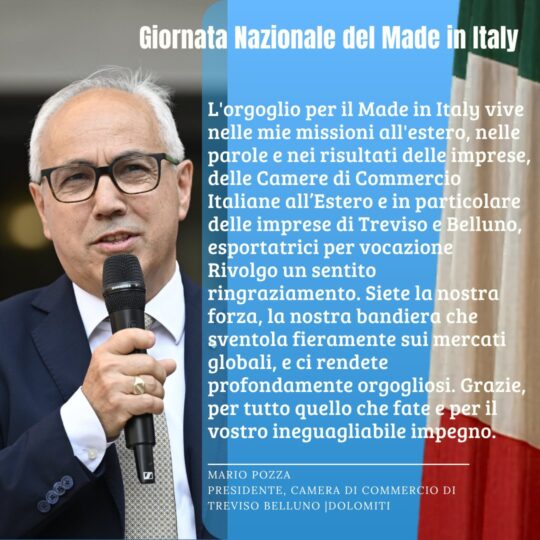
National Made in Italy Day – Statement by President Pozza