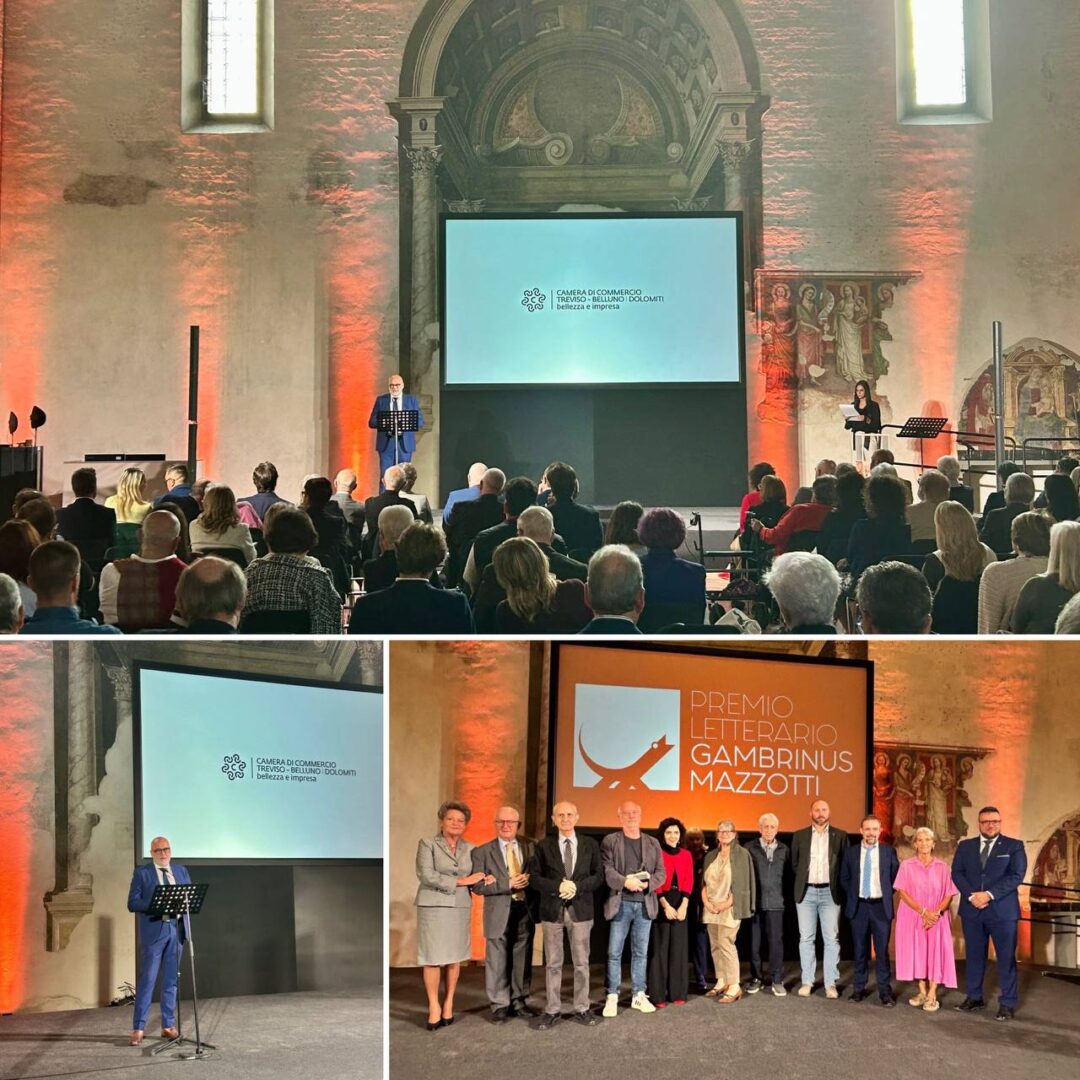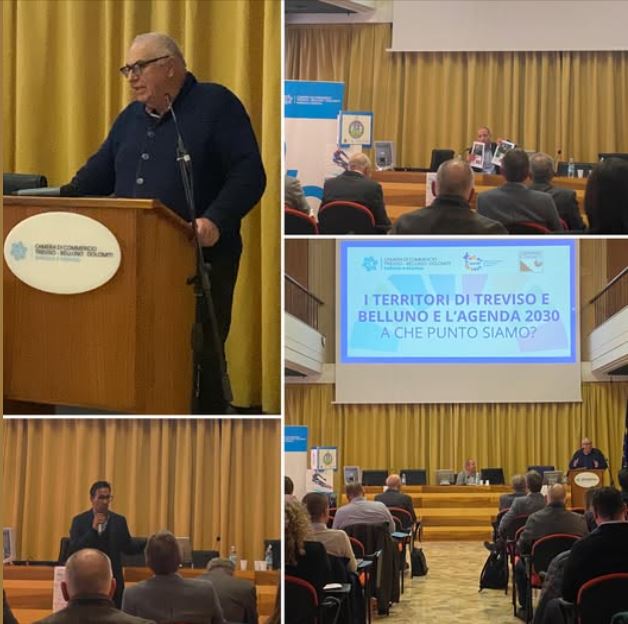
Treviso, March 27 2025 – At the Chamber of Commerce of Treviso – Belluno|Dolomiti, took place the conference “The territories of Treviso and Belluno and the 2030 Agenda. Where are we at?”, a time for discussion on the progress of the sustainable development goals in the two provinces.
During the meeting, the dashboards with their indicators were presented, which provide a detailed overview of the 2030 Agenda implementation in the territories of Treviso and Belluno. Additionally, the results of thematic focus groups on sustainable energy and education, two key areas for local development, were presented.
The speakers shared the good practices that emerged from the dialogue with the main stakeholders of the territory, highlighting virtuous experiences and effective strategies for achieving sustainability goals.
During the conference it was presented the research of the Economic and Social Observatory, carried out with the scientific contribution of AsVeSS – Venetian Association for Sustainable Development. The study, “Measuring to know and promote a sustainable territorial system”, analyzed the data and dynamics of the territory, offering useful tools for monitoring and promoting sustainability in the provinces of Treviso and Belluno.
Understanding the positioning of Treviso and Belluno in relation to the 2030 Agenda objectives – highlights Mario Pozza, President of the Chamber of Commerce – is vital to orient the strategies for sustainable development of the territory. I am glad that the proposal of the Chamber of Commerce has been accepted and developed by the Economic and Social Observatory, in collaboration with AsVeSS, giving rise to an important moment of comparison such as today’s conference. The event represents a moment of confrontation for institutions, local authorities and companies, which have undertaken a common path to integrate sustainability policies in territorial strategies, making them concrete tools for the benefit of the community. We must look consciously at the starting point, as we look at the future of the new generations to make our territory more attractive, creating opportunities of growth and development. It is essential to work on training, innovation and quality of life to retain talent and make Treviso and Belluno places where the new generations can choose to live and build their own future.
Today we are here to talk about action – comments Ivo Nardi, President of the Economic and Social Observatory of Treviso and Belluno – The project “Measuring to know and promote a sustainable territorial system” was born with an ambitious goal: to provide the provinces of Treviso and Belluno with a concrete tool to monitor and evaluate their path towards sustainability, in line with the 2030 Agenda goals. Through the release of two dashboards, one for Treviso and one for Belluno, we analyze more than 50 indicators to understand where we are and how we can improve. Operational tools and a starting point for workshops and discussions with the local communities. It is crucial that these data are not considered as just numbers, but become a stimulus for concrete and measurable actions. In parallel – continues Nardi – the project focuses on two key aspects of sustainability:
The first concerns the economic and labour dimension, with particular emphasis on educational pathways and the fight against school drop-out. The second focus is on energy, with the aim of ensuring that everyone has access to affordable, reliable and sustainable energy systems.
And we do not stop here. Analyzing the results, we have found other critical points that deserve further investigation. Among these, the theme of water is confirmed as one of the most urgent emergencies. All members decided, in the last meeting, to focus on this issue to identify effective strategies. Today – concludes President Nardi – we present the results of a path of research, but we will be the first to take new paths in order to face urgent challenges and make our territory increasingly attractive and sustainable.
Presentation
The territories of Treviso and Belluno and 2030 Agenda: Where are we at?
The search for a sustainable territorial development is an objective that sees a positive synergy between institutions, local entities, and enterprises that have embarked a common path to make sustainability policies a useful tool for the community.
What moves in this direction is the research of the Economic and Social Observatory of Treviso and Belluno, made thanks to the scientific contribution of AsVeSS, Veneto Association for Sustainable Development presented on March 27 within the conference “The territories of Treviso and Belluno and the 2030 Agenda: Where are we at?”.
This is a first measurement work to understand how the territories of the provinces of Treviso and Belluno are positioned in relation to the sustainable development goals of the 2030 Agenda, highlighting their advances, but also the delays and difficulties in their implementation, taking care not to leave anyone behind. The analysis, at provincial level, presents a clear and detailed picture based on 44 synthetic indicators drawn from numerous public sources, first of all ISTAT, the positioning of Treviso and Belluno in relation to the national average in the years 2021 or 2022 indicated with the values 100.
Among the strengths, where the territories of the provinces of Treviso and Belluno have a better average than the national one, are decent work (TV 120,4, BL 125,1), with the intersection of several indicators on the labour market – employment rate, the presence of young people between 15 and 29 years old who do not study or work, average pay – and the circular economy (TV 124,3, BL 110,8), which records the percentage of separate collection of urban waste and the amount of urban waste produced per capita (kg per inhabitant). These data reflect the attractiveness of the territory in terms of job opportunities and good waste management. Indicators above the national average for both provinces also regarding the reduction of inequalities (TV109,8, BL 106,7).
The health and well-being target has a positive value in Treviso (105.4), while the figure for Belluno is in line with the national average. In Belluno, on the other hand, the indicator of land consumption is well above average (126.9) due to the mountainous characteristics of the territory and a smaller population, which is very negative instead for the province of Treviso (72.4)
Among the weak points, where the figure is below the national average, the two territories have in common, although with different values, objectives such as: quality education (TV 79, BL 90,8), calculated from the synthesis of indicators on participation in continuing training, the % of graduates and other tertiary degrees and children aged 0-2 years who use childcare services and the presence of libraries; sustainable watewr management, sustainable cities (TV 89, BL 93.5) if in Belluno the indicator places –kilometers offered by local public transport (Tpl), in Treviso the problem is linked to the levels of exceedances of the Pm10 which remain vey worrying. The target for industry, innovation and infrastructure is also below the national average for both territories (TV 91.9, BL 78.5).
Comment of AsVeSS President Giorgio Santini
The Positioning Reports – stresses Giorgio Santini, President of AsVeSS – are part of the path we are taking at territorial level to measure the distance from the achievement of sustainability goals and stimulate a greater commitment by institutions, but also by economic and social realities, because what has been sdone so far is not enough. In addition to measuring where we are at, the research work has also produced two focus areas and some moments of listening to experiences carried out in the provincial territories dedicated respectively to the social dimension of sustainability, with reference to Goal 8 “Decent work and economic growth”, and the environmental dimension with reference to Goal 7 “Clean and accessible energy”.
For Objective 8, the focus has been on the NEET, young people who are neither studying nor working, a phenomenon which in recent years has taken on a central role in the debate on youth policies and the labour market, representing one of the most urgent challenges for the educational and socio-economic system.
The survey work focused on understanding the phenomenon in the provinces of Treviso and belluno, analysing the economic, social and cultural context, but above all reporting the direct experiences of young NEETs and the testimonies of educators, counsellors, teachers and other professionals working in the area.
The study shows that this condition is not simply the result of individual choice, but often the product of a complex set of factors interacting with each other. On the one hand, there are barriers linked to changes in the labour market, which in recent decades has seen a growing precariousness of professional opportunities and an increasing demand for increasingly specialized skills. On the other hand, the educational system often struggles to respond effectively to the needs of guidance and accompaniment, leaving some young people without tools to understand their inclinations and identify paths consistent with their aspirations and abilities. In addition to these factors, there are social and economic dynamics which can have a major impact on the life course of a young person.
For Objective 7, the focus achieved offers a thorough examination of the current state of the energy system in the provinces of Treviso and Belluno considering both the past and future context, in a period of epochal energy transition. Special attention is given to technological innovations and their impact on the territory, as well as to identify the relationship between the territory and the most promising energy sources, represented by photovoltaic and wood-based cellulosic biomasses, with the aim of enhancing local resources and promoting the development of sustainable solutions.
The study, through a quantitative assessment of the impacts resulting from energy and environmental policies, aimed to identify the key areas, the infrastructure needs and areas having intervention priority to accompany the transition in an increasingly complex and uncertain energy landscape. In this perspective, closer collaboration between institutions, citizens and enterprises will be essential, making the best use of the opportunities arising from a series of incentive instruments such as the recent programme Transition 5.0, the facilities provided by Conto Termico (Thermal Account, with the update to version 3.0 scheduled for 2025), the PNRR calls, the CACER decree. The latter in particular, by encouraging the involvement and collaboration between different actors in the territory in the production and consumption of renewable energy, promotes a more decentralized and sustainable energy system.
The research promoted by OES together with AsVeSS, through the positioning reports and thematic insihts, proposes itself as a useful and necessary tool to recognize the many critical situations at level and to encourage the definition of more effective policies and actions to respond to the socio-economic and environmental needs of a renewed territorial development: fairer, more inclusive and sustainable.