Comment by President Francesco De Bettin
I find it interesting to note what is summarized in the title of this report on trade between our two provinces in the first half of 2026: Overall, the export capacity of our businesses has remained largely stable, but as soon as we break down the analysis by sector and market, we see differing trends—or, in some cases, trends that cancel each other out—resulting from the geopolitical complexity of our times,” comments Francesco De Bettin, President of the Treviso-Belluno|Dolomiti Chamber of Commerce.
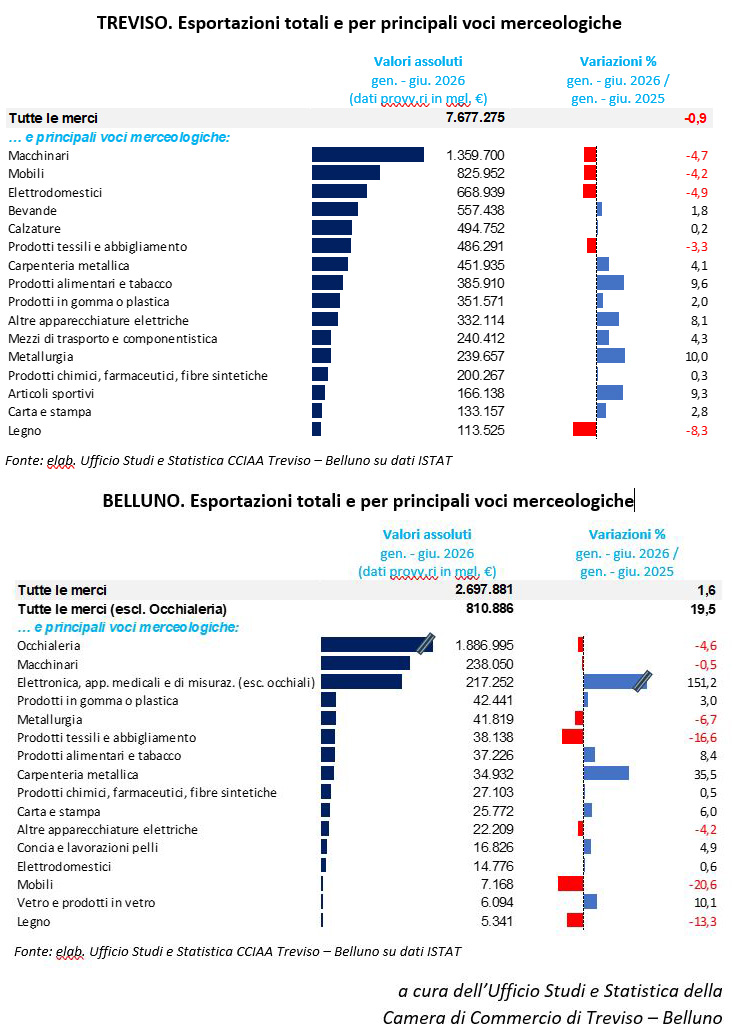
The situation in Belluno is emblematic: an apparent stability in provincial exports, but one that actually masks three divergent trends. Eyewear exports are down (-4.6% due to declines in Mexico and the United Arab Emirates, as well as in the U.S.); industrial machinery remains essentially stable (-0.5%); and sales of electronics and medical devices are growing exponentially (+151%, from 86.5 million in the first six months of last year to the current 217.3 million). This is a figure worth analyzing, as it likely includes the first pilot productions of “smart glasses” as well as growing demand for control systems for the cold chain, aimed at energy efficiency and predictive maintenance.
The situation in Treviso is equally interesting: considering the top 15 export sectors, four—unfortunately among the most significant—are “in the red,” but the other eleven are holding steady or even growing, including in the U.S. The report analyzes them one by one.
The four struggling sectors are industrial machinery, wood and furniture, household appliances, and textiles and apparel. But even within these individual sectors, we see this pattern of divergent trends, De Bettin continues.
Take Treviso’s machinery sector, for example: it is experiencing declines primarily in non-EU markets (-9.6%), and to a much lesser extent within the EU (-0.8%). Moreover, focusing on non-EU markets, sales are growing to the U.S. (+8.6%) and the United Kingdom (+10.2%). Unfortunately, these trends fail to offset the sharp declines to India (-43.9%; -15 million), China (-67.9%; -37 million), and the United Arab Emirates (-75.5%; -30.6 million). For China and India, this represents a significant negative shift compared to previous years. “We’ll see,” De Bettin wonders, “whether these fluctuations are linked to orders or are side effects of trade wars: my view is that behind these figures there may also be early signs—especially from China—of technological self-sufficiency, which are structurally reducing our market share.
As for the decline in the United Arab Emirates, I think the situation is relatively easier to interpret: the comparison is with a period marked by exceptional sales volumes, against the backdrop of growing investments that were taking place in that region, which were then interrupted by the disastrous Hormuz crisis.
Of the eleven Treviso sectors showing growth, five are “holding steady”: beverages (primarily Prosecco), footwear (again, growing within the EU but declining in non-EU markets), rubber and plastics, chemicals and pharmaceuticals, and paper and printing. The following sectors are growing: sporting goods (one of the core activities of our Montebelluna district), the food industry, metal fabrication, electrical equipment, metallurgy, transportation vehicles, and automotive components.
This last segment deserves a final comment from me,” concludes De Bettin. “It has seen a decline in exports, especially within the EU (-7.3%). However, it is holding up well in non-EU markets (+22.1%), particularly in the U.S., Serbia (where there are Stellantis plants), and Turkey (as is well known, one of the world’s most important automotive manufacturing hubs). These figures allow us to highlight the remarkable ability of our Treviso-based entrepreneurs to keep pace with the evolution of global supply chains.
But it is clear, based on the scenarios we have, that this process must be strengthened and replicated across all our sectors: we need to develop a new strategic understanding of how these supply chains are evolving and of the unique added value that we, as the Treviso and Belluno system, can bring to them.